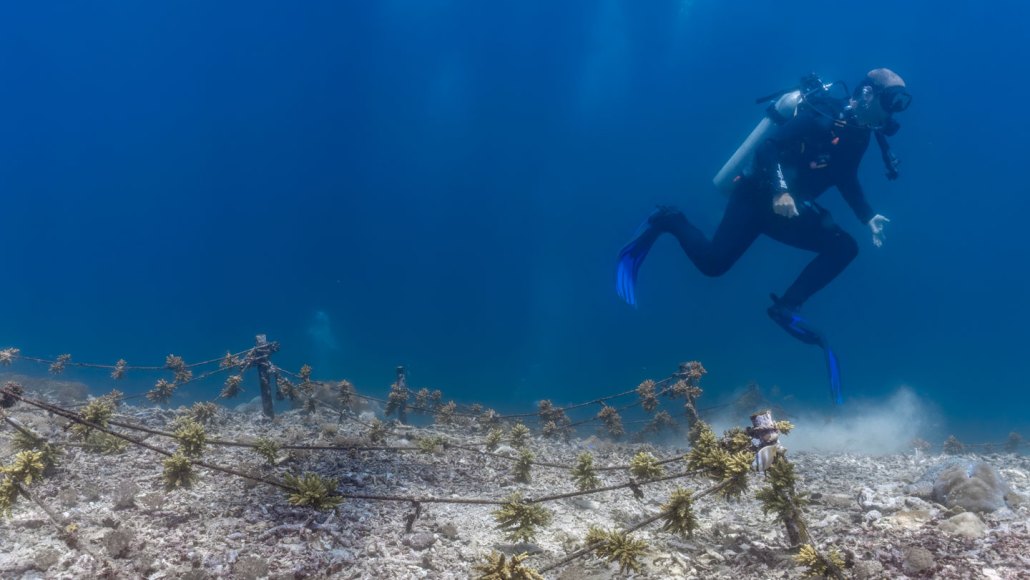
Scuba divers can inadvertently touch or damage the reef on dives. This diver in Bali, Indonesia, is kicking up sediment at a coral restoration site.
Bing Lin
Scuba divers may be beating up coral reefs more than they think.
Video analyses of divers show that more than 80 percent of damaging physical contact with the reef is unintended or simply unnoticed, researchers report May 26 in Conservation Letters. The findings show that routine diving practices aren’t harmless.
Scuba diving is often framed as one of the “good” ways to use reefs because it isn’t extractive, says Bing Lin, a marine conservation scientist at the University of Sydney. The fish remain in the water, and divers get to enjoy seeing them in the wild.
However, divers commonly damage reefs by kicking or grabbing corals or by disturbing wildlife. “What’s less understood is just how invisible much of this damage is to the people causing the harm,” Lin says.
Lin and his colleagues compared what divers thought they were doing underwater with what they were actually doing. Between December 2022 and January 2024, the team collected both survey and dive video data from 732 scuba divers at dive sites across Indonesia and the Philippines. The researchers filmed divers on the reef, logging their behaviors when they touched or damaged the reef. After the dives, the researchers interviewed the divers, asking them to estimate how often they contacted the reef and how that compared with their peers.
The team found that divers were touching the reef about one time per four minutes on average, and that about 60 percent of these touches were unintentional or done without the divers’ knowledge.
“Reef damage was pervasive, but usually not malicious,” Lin says.
Rather than bad intentions, overconfidence and a lack of situational awareness seem to be the key issues behind this. About 75 percent of the divers rated themselves as above average in their diving abilities and avoidance of reef impacts — all while touching the reefs five times more than they’d estimated. Wildlife sightings worsened reef bumping, more than doubling the rate of damaging contact.
On some popular reefs with thousands of divers and snorkelers per day, the accumulating damage could have “substantial ecological impacts,” Lin says.
Fabio Favoretto, a marine ecologist at the University of Plymouth in England who was not involved with the research, notes that about 15 percent of the divers never touched the reef at all, calling it a hopeful finding.
“That’s the proof that this is fundamentally a fixable problem by training and regulation, not an inherent feature of diving,” Favoretto says.
An important next step, he says, is to see whether diver behavior is linked to measurable effects on overall reef health. What actually happens to a reef over five or 10 years if it’s touched once every four minutes?
He and Lin both highlight that hanging up the fins isn’t a solution. Reef tourism plays an important role in reef conservation and provides economic incentives to keep these ecosystems intact.
“Ultimately, the goal is not to stop people from diving, but helping people dive better,” Lin says.