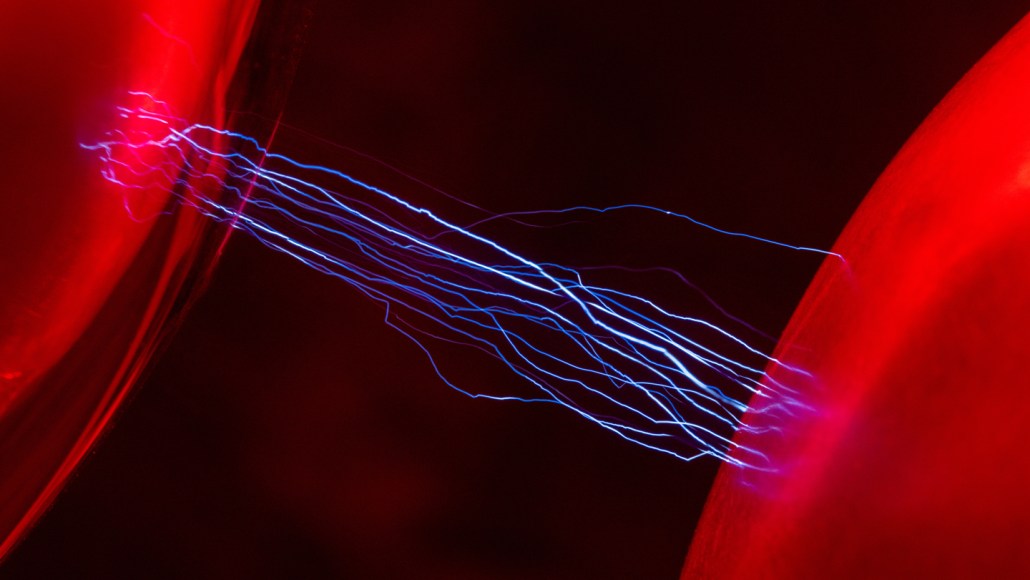
Static electricity, a charge buildup caused by rubbing or touching, is a poorly understood phenomenon, despite its prevalence.
Craig P. Jewell/Moment/Getty Images
DENVER — Static electricity is a touchy subject.
Touch or rub two materials together, and they can exchange electric charge. But the details behind the phenomenon of static electricity are poorly understood. Now, scientists have identified a hidden factor at play. A thin veneer of carbon-rich molecules alters how identical materials exchange charge, scientists report in the March 19 Nature. That suggests that surface contamination plays a major role in static electricity.
“Static electricity is not child’s play,” physicist Scott Waitukaitis said in a March 16 talk at the American Physical Society’s Global Physics Summit. “Quite literally, it could be the reason that we have ground to stand on.” The charge created by colliding particles in protoplanetary disks is thought to help planets, including Earth, form. It’s also the source of volcanic lightning, helps buoy sand lofted in dust storms and can cause industrial accidents such as fires in sawmills.
When two identical particles crash into each other, one gains a positive charge and the other goes negative. But scientists didn’t know what determines which particle gets which charge. Waitukaitis and colleagues investigated this effect in silicon dioxide, or silica, a commonly occurring material found in sand, rock and glass.
The researchers bounced a tiny silica sphere off a silica plate and measured the charge the sphere gained. To do this, scientists used a technique called acoustic levitation, harnessing sound waves to suspend the half-millimeter silica bead in midair before dropping it. That technique avoided any unwanted effects from physically touching the object.
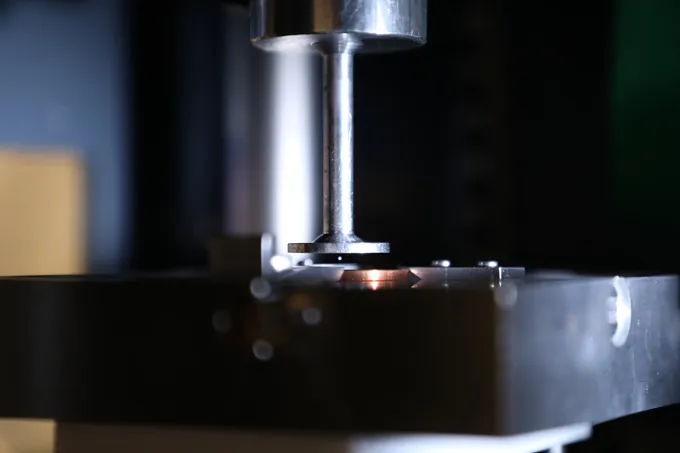
Some spheres charged positively while the plate charged negatively. But some interactions went the other way. However, if the researchers heated the sphere or plate to 200° Celsius for two hours, and then let it cool, they could manipulate the effect. A previously heated sphere almost always charged negatively to an untreated plate, while a heated plate made the sphere charge positive. The same thing happened when the spheres were exposed to plasma, a mix of electrically charged particles. In both cases, the treated object picked up a negative charge, and the unadulterated one became positively charged.
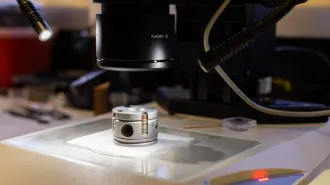
Close inspection of the materials revealed that the heat and plasma treatments stripped off a thin layer of carbon-rich molecules from the surface of the silica. Almost every object exposed to air is similarly encrusted, thanks to ever-present organic molecules floating around. “This carbon cake, it just grows on everything, in every environment,” says Waitukaitis, of the Institute of Science and Technology Austria in Klosterneuburg.
After a sphere was heat-treated, its carbon layer returned over several hours, due to exposure to carbon-rich molecules in the air. The sphere’s charging behavior approached its original baseline in lockstep with the carbon layer’s growth, suggesting that the carbon layer was responsible for the change in how the objects charge.
“That really nailed it down, that the two things were changing at the same time scale,” says chemical engineer Daniel Lacks of Case Western Reserve University in Cleveland, who was not involved with the research.
Scientists had long suspected that surface contamination — by carbon or other substances — was important for understanding static electricity. The new study “proves the general point very clearly that uncontrolled surface contaminations play a major role,” says materials scientist Laurence Marks of Northwestern University in Evanston, Ill. But it’s not the end of the story. Previous experiments, he says, have found other factors to be relevant, such as the curvature of a surface.
Even a small change to the carbon layer can alter the results of an experiment, says physicist Rolf Möller of the University of Duisburg-Essen in Germany. “This work nicely shows that one has to be very careful about the … influence of contaminations.”
The study’s conclusions apply to silica and related materials, called insulating oxides. But the importance of understanding surface effects is general. In an earlier study, Waitukaitis and colleagues found that static electricity between squishy polymers depended on how many times they’d been touched and how smooth their surfaces were as a result.
The researchers still don’t know how altering the carbon layer changes the result of an experiment, or even how charge is actually exchanged between objects. But the work could spark better understanding of an electrifying phenomenon.