Science in the News
- Health & Medicine
How fear and anger change our perception of coronavirus risk
Americans are weighing whether to return to society. Behavioral scientist Jennifer Lerner discusses how emotions drive those decisions.
- Health & Medicine
The new COVID-19 drug remdesivir is here. Now what?
Remdesivir may shorten recovery time for some people, but it isn’t available to everyone and it won’t end the pandemic on its own.
- Health & Medicine
Door-to-door tests help track COVID-19’s spread in one Oregon town
Surveying neighborhoods directly may give a more accurate view than mail-in tests and other methods, researchers say.
- Health & Medicine
To end social distancing, the U.S. must dramatically ramp up contact tracing
Life after social distancing may involve apps that ask you to self-isolate after you’ve been near someone who tests positive for COVID-19.
- Health & Medicine
What coronavirus antibody tests tell us — and what they don’t
Antibody tests can give a clearer picture of who has been infected but don’t guarantee immunity for those who test positive.
- Health & Medicine
COVID-19 kills more men than women. The immune system may be why
Countries with sex-specific data report more men than women are dying of the coronavirus. Women’s stronger immune response may give them a leg up.
- Health & Medicine
COVID-19 is hitting some patients with obesity particularly hard
Doctors say some of their sickest COVID-19 patients are young and obese. One study shows they have higher rates of hospital admission and death.
- Physics
Gravitational waves have revealed the first unevenly sized black hole pair
For the first time, LIGO and Virgo scientists spotted gravitational waves produced when one big black hole merged with a smaller one.
- Humans
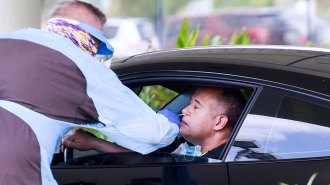
Here’s where things stand on COVID-19 tests in the U.S.
Government officials are weighing how to loosen social distancing measures across the United States, but that hinges on widespread COVID-19 testing.
- Health & Medicine
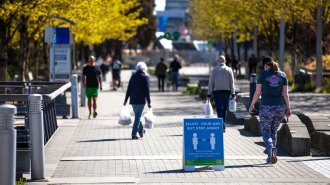
Why 6 feet may not be enough social distance to avoid COVID-19
Scientists who study airflow warn that virus-laden drops may travel farther than thought.
- Health & Medicine
Why African-Americans may be especially vulnerable to COVID-19
African-Americans are more likely to die from COVID-19 than white Americans, data show. Experts blame long-standing health disparities.
- Health & Medicine
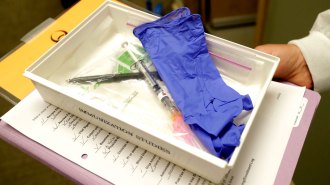
Meet Sophia Upshaw, a volunteer in a coronavirus vaccine trial
In Seattle and Atlanta, scientists have started testing the safety of a potential vaccine to prevent COVID-19.