Astronomy
- Astronomy
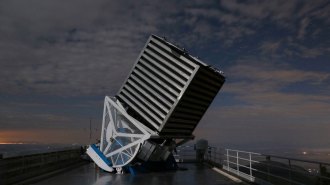
An arc of galaxies 3 billion light-years long may challenge cosmology
Dubbed “the Giant Arc,” the purported structure is much larger than expected in a cosmos where matter is thought to be evenly distributed.
- Astronomy
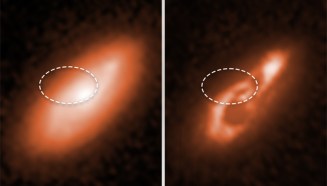
Some fast radio bursts come from the spiral arms of other galaxies
Tracking five brief, bright blasts of cosmic radio waves to their origins suggests their sources form quickly in regions with lots of star formation.
- Astronomy
Record-breaking light has more than a quadrillion electron volts of energy
Hundreds of newly detected gamma rays hint at cosmic environments that accelerate particles to extremes.
- Astronomy
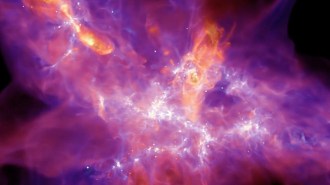
Watch this beautiful, high-resolution simulation of how stars are born
The STARFORGE simulation follows a giant gas cloud as it collapses into new stars, accounting for all the phenomena thought to influence the outcome.
- Astronomy
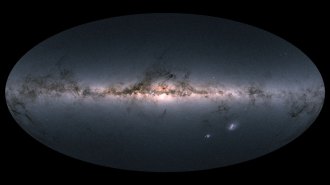
The Milky Way may have grown up faster than astronomers suspected
Most of the galaxy’s disk was in place before a merger 10 billion years ago with a dwarf galaxy called Gaia-Enceladus/Sausage, a new study suggests.
- Astronomy
A study of Earth’s crust hints that supernovas aren’t gold mines
Supernovas aren’t the main source of gold, silver and other heavy elements, a study of deep-sea crust suggests.
- Space
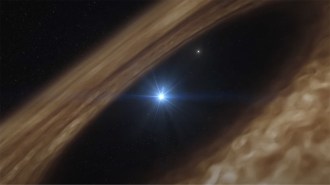
Planet-forming disks around stars may come preloaded with ingredients for life
Methanol spotted around a hot, young star probably originated in interstellar space, suggesting some chemistry for life may start before stars form.
- Astronomy
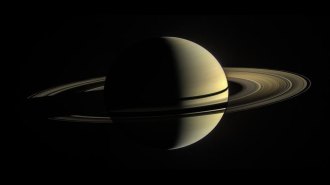
Saturn has a fuzzy core, spread over more than half the planet’s diameter
Analysis of a wave in one of Saturn’s rings has revealed that the planet’s core is diffuse and bloated with lots of hydrogen and helium.
- Space
A rare glimpse of a star before it went supernova defies expectations
A hydrogen-free supernova in a nearby galaxy appears to have come from an unusual source.
- Space
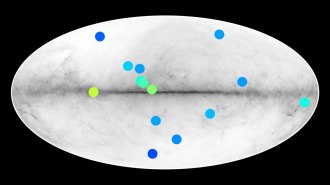
Stars made of antimatter could lurk in the Milky Way
Fourteen celestial sources of gamma rays provide preliminary hints of matter colliding with “antistars” in our galaxy.
- Astronomy
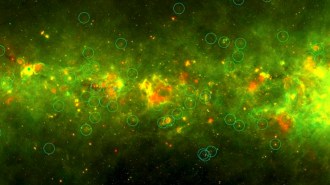
Mysterious ‘yellowballs’ littering the Milky Way are clusters of newborn stars
The first comprehensive analysis of the celestial specks indicates they are clusters of infant stars of various masses.
- Astronomy
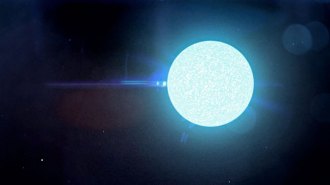
Neutron stars may not be as squishy as some scientists thought
NASA’s NICER X-ray telescope finds that the most massive known neutron star has an unexpectedly large diameter.