Earth
We summarize the week's scientific breakthroughs every Thursday.
- Animals
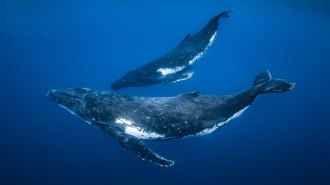
This humpback whale hunting strategy has been out of sight — until now
Scientists documented humpback whales hunting together at the seafloor, coordinating their arrival to scoop up sand lances.
- Oceans
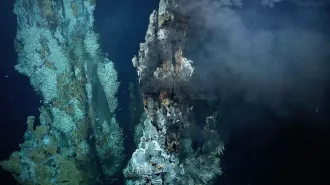
Deep-sea snails ride surface currents to reach distant hydrothermal vents
The finding shows how life spreads between isolated deep-sea vents — and how closely those ecosystems are tied to the sunlit ocean.
- Climate
A new map traces the sky’s water highways
Atmospheric rivers bring heavy rain and floods, but if they don’t come around, it could mean drought. A new global map reveals little-known pathways.
- Climate
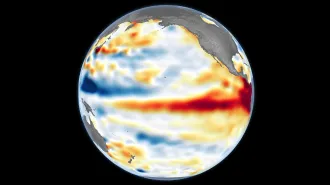
Can geoengineering blunt El Niño’s fury?
Marine cloud brightening could cool part of the Pacific and weaken extreme El Niños, simulations suggest. But the approach could have risks.
- Climate
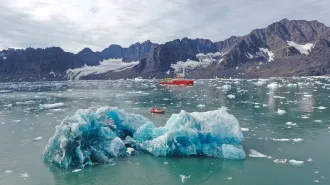
A robot swarm is on a mission to map Greenland’s perilous ice sheets
The ambitious expedition aims to fill data gaps about the glacier-sea boundary to predict when the world might tip into a catastrophic climate regime.
- Agriculture
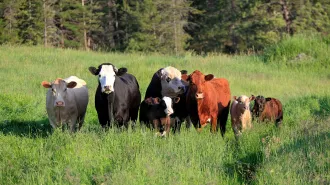
Scientists say Beefalo are all beef, no -alo. Breeders disagree
A whole-genome analysis of Beefalo, a hybrid bison-cattle breed, suggests very few individuals have any bison DNA at all, a new study reports.
- Plants
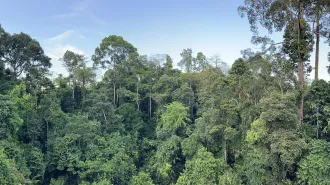
Giant trees have tricks to work around drought
Samples collected at daring heights provide evidence for an untested theory of tree drought adaptation, while countering another.
- Animals
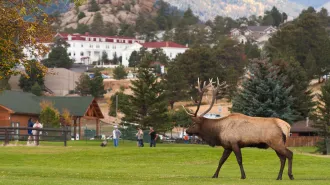
The animal behind most aggressive wildlife encounters may surprise you
Analysis of 3,000 incidents in Canada reveals which animal–human activity combos are especially risky. Of note: Elk and campgrounds are a bad mix.
- Microbes
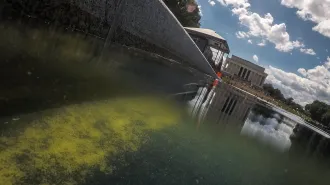
New science on algae die-offs is too late for the Reflecting Pool
Iron and hydrogen peroxide trigger cell death via ferroptosis, which cascades killer molecules through the population, causing mass die-offs of algae.
- Earth
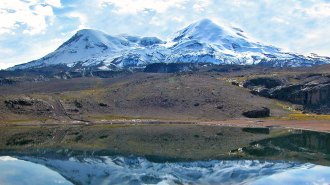
A tropical permafrost layer in Peru may be one of the world’s largest
Vast permafrost beneath the upper slopes of Peru’s tallest volcano could become a regional water source as glaciers in the Andes retreat.
- Earth
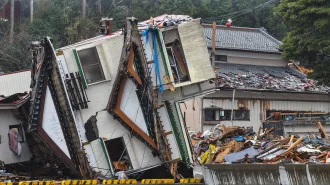
A 2011 earthquake bounced a seismic wave off Earth’s core, nudging Japan east
The wave's round trip to Earth's core set off a fault slip along Japan's plate boundaries, revealing a seismic hazard scientists hadn't recognized.
- Climate
A ‘Super El Niño’ may be on the way. What does that mean?
Past super El Niños have brought bad flooding, deadly fires and disease outbreaks. Climate experts already expect “shockingly high” temps this winter.