Humans
We summarize the week's scientific breakthroughs every Thursday.
- Health & Medicine
This week in Zika: Haiti hit early, possible monkey hosts, and more
A new test for Zika, how Haiti fits into the outbreak timeline, a look at monkeys that can carry the virus, and more in this week’s Zika Watch.
- Archaeology
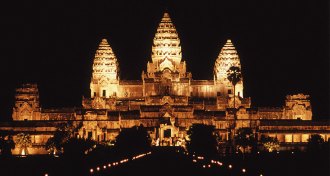
Lasers unveil secrets and mysteries of Angkor Wat
The world’s largest temple, Cambodia’s Angkor Wat, was revealed by laser and radar studies to be part of a sprawling medieval metropolis.
- Neuroscience
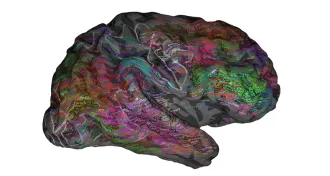
Words’ meanings mapped in the brain
Language isn’t just confined to one region of the brain: The meaning of words spark activity all over the cerebral cortex.
- Archaeology
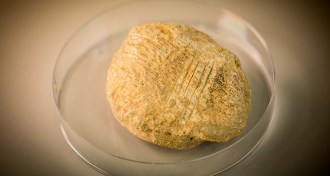
Bear bone rewrites human history in Ireland
A rediscovered bear bone puts humans in Ireland at least 12,600 years ago.
- Humans
Gelada monkeys know their linguistic math
The vocalizations of gelada monkeys observe a mathematical principle seen in human language, a new study concludes.
- Health & Medicine
Here’s some slim science on temper tantrums
Scientists have mapped the structure of toddlers’ tantrums, but preventives are hard to come by.
- Neuroscience
Left brain stands guard while sleeping away from home
Part of the left hemisphere stands sentry while the rest of the brain and body snooze.
- Health & Medicine
‘Dirty’ mice better than lab-raised mice for studying human disease
Dirtier mice may better mimic human immune reactions.
- Anthropology
Belize cave was Maya child sacrifice site
Bones in Central American cave suggest many Maya sacrificial victims were children.
- Humans
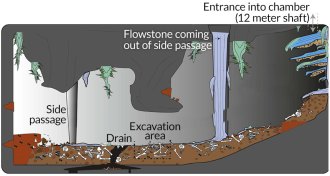
Pieces of Homo naledi story continue to puzzle
Researchers defend Homo naledi as a new hominid species and debate how it reached an underground cave.
- Health & Medicine
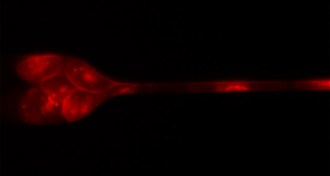
Clusters of cancer cells get around by moving single file
Clusters of cancer cells squeeze through thin blood vessels by aligning single file.
- Science & Society
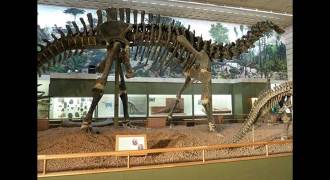
‘House of Lost Worlds’ opens vaults of renowned natural history museum
'House of Lost Worlds' pays homage to Yale’s Peabody Museum of Natural History and to the colorful scientists who made the museum great.