Math
We summarize the week's scientific breakthroughs every Thursday.
- Neuroscience
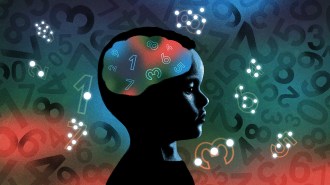
Why is math harder for some kids? Brain scans offer clues
Kids with math learning disabilities process number symbols differently than quantities shown as dots — and it shows up in MRIs.
- Physics
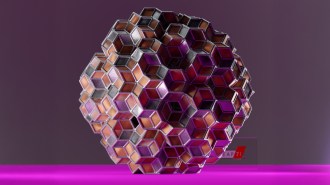
Physicists dream up ‘spacetime quasicrystals’ that could underpin the universe
Quasicrystals are orderly structures that never repeat. Scientists just showed they can exist in space and time.
- Archaeology
This ancient pottery holds the earliest evidence of humans doing math
Flower designs on 8,000-year-old Mesopotamian pots reveal a “mathematical knowledge” perhaps developed to share land and crops, archaeologists say.
- Physics
There’s math behind this maddening golf mishap
Math and physics explain the anguish of a golf ball that zings around the rim of the hole instead of falling in.
- Math
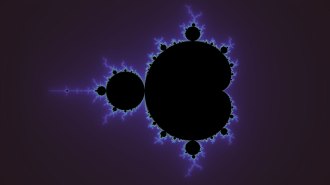
See how fractals forever changed math and science
Over the last half 50 years, fractals have challenged ideas about geometry and pushed math, science and technology into unexpected areas.
- Computing
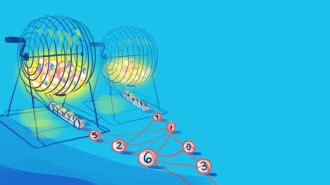
There’s no cheating this random number generator
From jury duty to tax audits, randomness plays a big role. Scientists used quantum physics to build a system that ensures those number draws can’t be gamed.
- Plants
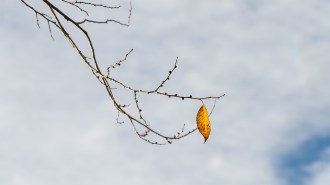
A leaf’s geometry determines whether it falls far from its tree
Shape and symmetry help determine where a leaf lands — and if the tree it came from can recoup the leaf’s carbon as it decomposes.
- Math
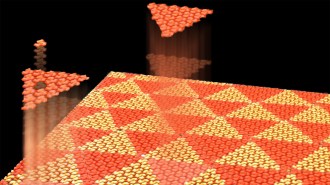
The einstein tile rocked mathematics. Meet its molecular cousin
Chemists identify a single molecule that naturally tiles in nonrepeating patterns, which could help build materials with novel electronic properties.
- Math
Two teenagers have once again proved an ancient math rule
Ne’Kiya Jackson and Calcea Johnson have published 10 trigonometric proofs of the Pythagorean theorem, a feat thought impossible for 2,000 years.
- Math
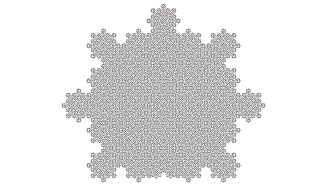
This intricate maze connects the dots on quasicrystal surfaces
The winding loop touches every point without crossing itself and could help make a unique class of atomic structures more efficient catalysts, scientists say.
- Math
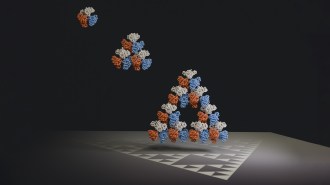
Scientists find a naturally occurring molecule that forms a fractal
The protein assembles itself into a repeating triangle pattern. The fractal seems to be an accident of evolution, scientists say.
- Math
How two outsiders tackled the mystery of arithmetic progressions
Computer scientists made progress on a decades-old puzzle in a subfield of mathematics known as combinatorics.