Math
We summarize the week's scientific breakthroughs every Thursday.
- Math
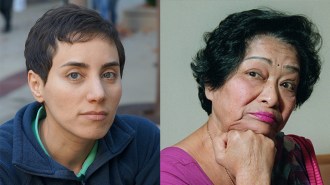
A documentary and a Bollywood film highlight two disparate paths in mathematics
An unlikely pair of films recount tales of two very different mathematical women, Maryam Mirzakhani and Shakuntala Devi.
- Computing
How next-gen computer generated maps detect partisan gerrymandering
The U.S. census will trigger a new round of redistricting beginning in 2021. Researchers have developed numerous tests to identify gerrymandering.
- Animals
Calculating a dog’s age in human years is harder than you think
People generally convert a dog’s age to human years by multiplying its age by seven. But a new study shows the math is way more complex.
- Math
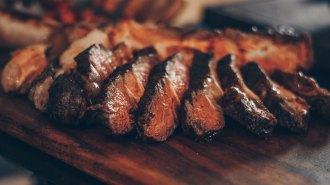
To cook a perfect steak, use math
As a steak cooks in an oven, movement of liquid within the meat causes it to become extra juicy in the center in a way that can be predicted by mathematics.
- Science & Society
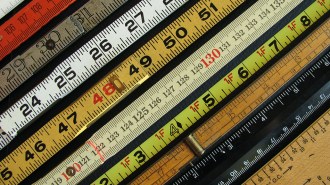
The U.S. has resisted the metric system for more than 50 years
Australia adopted the metric system 50 years ago. The United States tried by passing legislation for a voluntary conversion that was largely ignored.
- Math
How large a gathering is too large during the coronavirus pandemic?
Mathematical models explain why large gatherings are especially dangerous in an epidemic, and identify how large is too large.
- Space
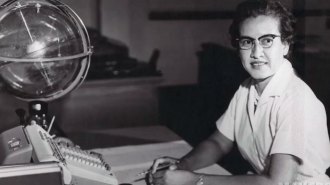
NASA icon Katherine Johnson has died at the age of 101
The “Hidden Figure” captured the public’s admiration after the story of her career was publicized in a 2016 book and film.
- Math
How a quantum technique highlights math’s mysterious link to physics
Verifying proofs to very hard math problems is possible with infinite quantum entanglement.
- Physics
A quantum strategy could verify the solutions to unsolvable problems — in theory
A quantum technique for verifying solutions to difficult problems could apply to an “unbelievably huge” class of puzzles.
- Math
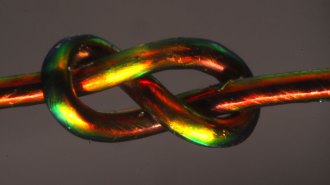
Color-changing fibers help reveal mysteries of how knots work
Experiments with colorful fibers helped scientists discover a few simple rules behind knots’ varying strengths.
- Science & Society
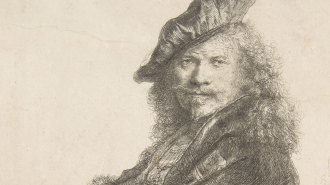
Why Rembrandt and da Vinci may have painted themselves with skewed eyes
A strongly dominant eye, not an eye disorder, may explain why some great artists painted themselves with one eye turned outward.
- Math
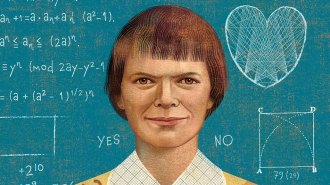
How Julia Robinson helped define the limits of mathematical knowledge
Born 100 years ago, Julia Robinson played a key role in solving Hilbert’s 10th problem.