Physics
We summarize the week's scientific breakthroughs every Thursday.
- Physics
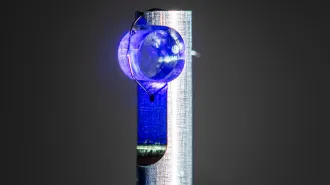
Clocks made from an atomic nucleus just ticked on for the first time
First dreamed up decades ago, the world's first nuclear clocks are set to improve quickly, becoming more precise and aiding the hunt for dark matter.
- Quantum Physics
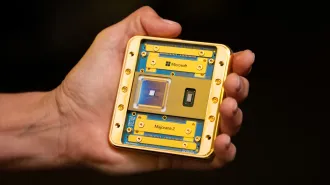
Microsoft’s quantum chip got an upgrade. Critics are still skeptical
Swapping materials in its Majorana 2 chip boosted the effectiveness of quantum bits that rely on the math of topology to reduce errors, Microsoft says.
- Physics
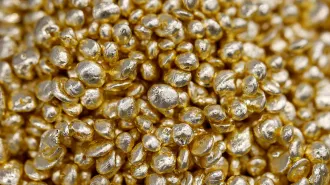
Physics explains why gold stays pristine
Metals like copper oxidize — reacting with oxygen in the air — but gold doesn’t, thanks to a quick switch in atom arrangement on its surface.
- Earth
Never-ending storms make for good plot twists. Could they plague Earth?
While the thunderstorms in The Legend of Zelda defy physics, plenty of places on Earth experience extreme weather.
- Physics
Water drops on soap bubble films act like merging galaxies
Water droplets on soap films orbited and merged like colliding galaxies, a technique that could help scientists study the cosmos.
- Physics
To get string theory, you need only four physics assumptions
Tenets of quantum mechanics and special relativity, among other theoretical ideas, lead inexorably to string theory.
- Particle Physics
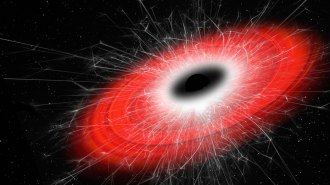
To understand black holes, physicists turn to a mathematical ‘Rosetta stone’
A link between particle physics and gravity equations, called the double copy, applies to Hawking radiation, creating a new way into black hole puzzles.
- Quantum Physics
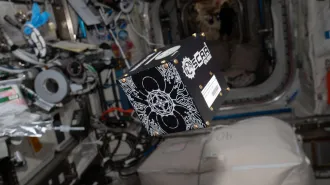
A grapefruit-sized quantum device mapped Earth’s magnetic field from space
On the International Space Station, a cube holding a diamond-based sensor revealed the potential for quantum magnetometers.
- Physics
The secret to perfect espresso? It’s physics
Inspired by gas and liquid flow in earth science, researchers brewed an equation to calculate the speed of water percolation through ground coffee.
- Particle Physics
A strange ‘neutrino force’ helped heal a crack in particle physics
A neglected force produced by neutrinos and other particles helps atomic physics measurements align with predictions of the standard model.
- Physics
A new measurement reveals gravity is still hard to pin down
After a 10-year effort, physicists got a value for “Big G” that does not settle the debate over one of nature’s hardest numbers to nail down.
- Cosmology
Exploding black holes could explain an antimatter mystery
Shock waves from tiny black holes in the early universe could explain how antimatter became so rare while matter is common.