Tech
We summarize the week's scientific breakthroughs every Thursday.
- Physics
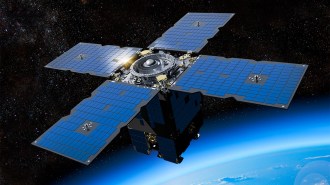
An atomic clock that could revolutionize space travel just passed its first test
The most precise clock ever sent to space successfully operated in Earth’s orbit for over a year.
- Animals
The teeth of ‘wandering meatloaf’ contain a rare mineral found only in rocks
The hard, magnetic teeth of the world’s largest chiton contain nanoparticles of santabarbaraite, a mineral never seen before in biology.
- Astronomy
Watch this beautiful, high-resolution simulation of how stars are born
The STARFORGE simulation follows a giant gas cloud as it collapses into new stars, accounting for all the phenomena thought to influence the outcome.
- Neuroscience
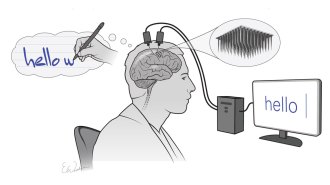
Brain implants turn imagined handwriting into text on a screen
A person who was paralyzed from the neck down was able to communicate, thanks to brain-to-text technology.
- Neuroscience
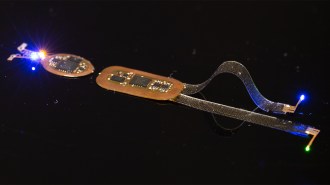
Scientists remotely controlled the social behavior of mice with light
New devices — worn as headsets and backpacks — rely on optogenetics, in which bursts of light toggle neurons, to control mouse brain activity.
- Science & Society
Videocalling needed more than a pandemic to finally take off. Will it last?
Zoom and social distancing ushered in the futuristic videophone fantasy AT&T wanted and consumers rejected for decades.
- Animals
How researchers can keep birds safe as U.S. wind farms expand
Tracking bald eagle abundance and migrating whooping cranes provides a clearer picture of where wind turbines could be safely built.
- Tech
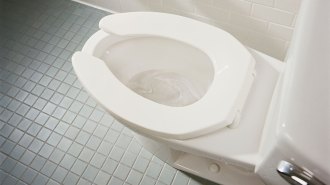
‘Pipe Dreams’ flushes out hope in an unexpected place: the toilet
A new book shows how reimagined toilets will allow humans to use pee and poop as natural resources.
- Tech
A new laser-based random number generator is the fastest of its kind
A new laser’s chaotic light beam lets the device generate multiple number sequences at once, similar to throwing multiple dice at a time.
- Chemistry
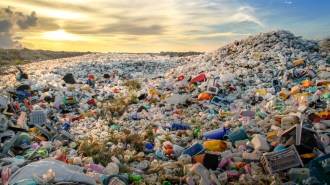
Chemists are reimagining recycling to keep plastics out of landfills
Recycling plastics is really hard, and usually creates low-quality materials that aren’t good for much. Chemists are trying to change that.
- Tech
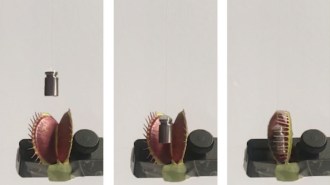
A robot arm toting a Venus flytrap can grab delicate objects
By attaching electrodes to the plant’s leaves, researchers found a way to snap its traps shut on command.
- Chemistry
Zinc-air batteries are typically single-use. A new design could change that
Swapping out the electrolyte in zinc-air batteries helps these next-gen power sources last longer.