Tech
We summarize the week's scientific breakthroughs every Thursday.
- Health & Medicine
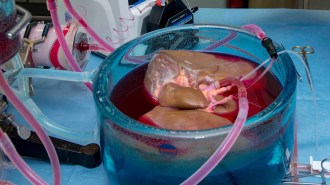
50 years ago, scientists hoped freezing donor organs would boost transplants
In the 1970s, biologists hoped to freeze organs so more could last long enough to be transplanted. Scientists are now starting to manage this feat.
- Tech
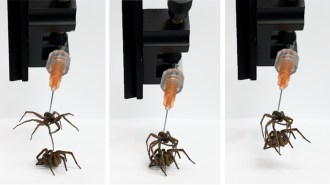
Scientists turned dead spiders into robots
In a new field dubbed “necrobotics,” researchers used a syringe and some superglue to control the dead bodies of wolf spiders.
- Neuroscience
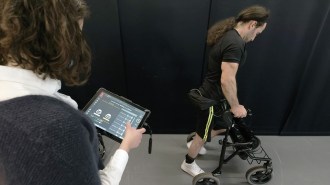
Spinal stimulation gives some people with paralysis more freedom
Methods that stimulate the spine with electrodes promise to improve the lives of people with spinal cord injuries, in ways that go well beyond walking.
- Health & Medicine
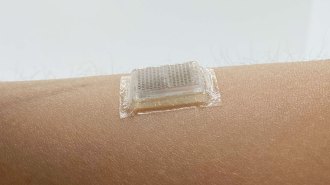
This stick-on ultrasound patch could let you watch your own heart beat
A new, coin-sized ultrasound probe can stick to the skin like a Band-Aid for up to two days straight, marking a milestone in personalized medicine.
- Environment
How to make jet fuel from sunlight, air and water vapor
Solar kerosene could one day replace petroleum-derived jet fuel in airplanes and help stabilize greenhouse gas emissions.
- Health & Medicine
A new technology uses human teardrops to spot disease
A proof-of-concept technique to analyze microscopic particles in tears could give scientists a new way to detect eye disease and other disorders.
- Tech
This octopus-inspired glove helps humans grip slippery objects
The human hand, for all its deftness, is not great at grasping slippery stuff. A new glove aims to change that.
- Health & Medicine
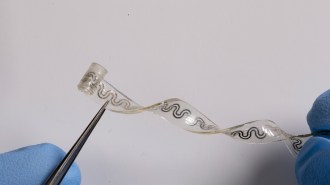
This soft, electronic ‘nerve cooler’ could be a new way to relieve pain
A tiny electronic device implanted in the body generates targeted pain relief by cooling off nerves, experiments in rats suggest.
- Tech
A neck patch for athletes could help detect concussions early
The small sensor is sleeker and cheaper than other devices used to monitor neck strain in athletes.
- Tech
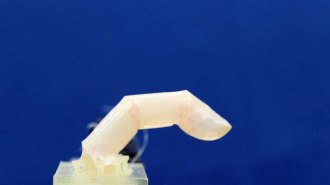
Scientists grew living human skin around a robotic finger
In the hopes of one day building super realistic cyborgs, researchers built a robotic finger that wears living human skin.
- Computing
The world’s fastest supercomputer just broke the exascale barrier
The Frontier supercomputer at Oak Ridge National Laboratory in Tennessee clocked in at more than 1.1 quintillion calculations per second.
- Tech
This camera lens can focus up close and far away at the same time
Inspired by the eye of an extinct trilobite species, the large depth of field can help with imaging techniques to create 3-D photos.