Tech
We summarize the week's scientific breakthroughs every Thursday.
- Health & Medicine
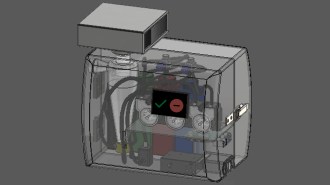
A new device can detect the coronavirus in the air in minutes
The detector can sense as a few as seven to 35 coronavirus particles per liter of air — about as sensitive as a PCR test but much quicker.
- Physics
Physicists split bits of sound using quantum mechanics
New experiments put phonons — the tiniest bits of sound — into quantum mechanical superpositions and show they are as weird as other quantum entities.
- Tech
How understanding horses could inspire more trustworthy robots
Computer scientist Eakta Jain pioneered the study of how human-horse interactions could help improve robot design and shape human-robot interactions.
- Tech
Deblina Sarkar is building microscopic machines to enter our brains
The ultratiny devices can communicate wirelessly from inside living cells and may one day help cure brain diseases.
- Tech
A flower-shaped soft robot could make brain monitoring less invasive
Once inserted in the skull, the device unfurls flexible sensors that can monitor the brain's electrical activity less invasively than current methods.
- Tech
50 years ago, a balloon circumnavigated the world for science
A 1973 high-altitude flight kicked off an era of useful stratospheric balloon science. Some scientists worry that heightened concerns over alleged spy balloons might hamper that.
- Tech
How ChatGPT and similar AI will disrupt education
The new chatbot ChatGPT and other generative AI encourage cheating and offer up incorrect info, but they could also be used for good.
- Tech
A trick inspired by Hansel and Gretel could help rovers explore other worlds
Taking a cue from a classic fairy tale, scientists propose a way for rovers to send back data from treacherous terrain.
- Health & Medicine
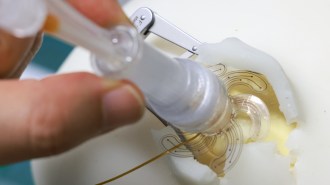
A gel cocktail uses the body’s sugars to ‘grow’ electrodes in living fish
A chemical reaction with the body’s own sugars turned a gel cocktail into a conducting material inside zebrafish brains, hearts and tail fins.
- Tech
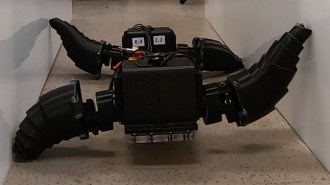
This robot automatically tucks its limbs to squeeze through spaces
Inspired by ants, a robot with telescoping legs can crawl under low ceilings, climb over steps and move on grass, loose rock and mulch.
- Physics
A powerful laser can redirect lightning strikes
In a mountaintop experiment, a laser beamed into the sky created a virtual lightning rod that snagged several bolts before they hit the ground.
- Earth
Rare earth mining may be key to our renewable energy future. But at what cost?
We take you inside Mountain Pass, the only rare earth mine in the United States.