CERN shutters the Large Hadron Collider for a major transformation

The particle smasher famously enabled discovery of the Higgs boson
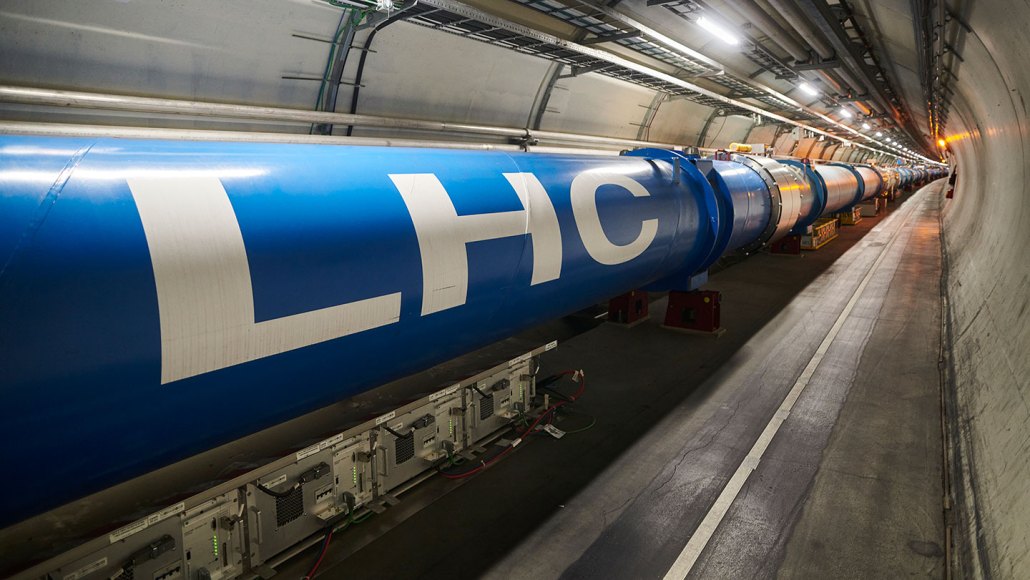
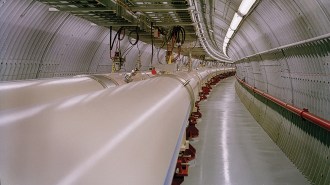
Scientific equipment with "LHC" written on it is pictured in a long tunnel.

The Large Hadron Collider accelerated protons in its underground tunnel (shown). It’s now been shut down in preparation for a major upgrade.

© CERN (CC-BY-4.0)

It’s the end of an era for particle physicists: They just said good-bye to the famed Large Hadron Collider — in its current form, anyway.

The LHC, the particle collider at the European particle physics lab CERN near Geneva, shut down June 29 to prepare for the next-generation machine. The High-Luminosity LHC is scheduled to start up in 2030.

Since 2010, the LHC has been accelerating protons to high energies and smashing them together inside its underground ring, which is 27 kilometers around and straddles France and Switzerland. Its most notable accomplishment is enabling the discovery of the Higgs boson, a subatomic particle that explains the origins of mass. That breakthrough was announced by the ATLAS and CMS experiments, located at the collider, in 2012.

The upcoming HL-LHC will feature a dramatic increase in collision rate compared with the LHC. That’s thanks to a boost to the collider’s luminosity, a measure of how tightly crammed the protons in its beams are. The HL-LHC will have up to 10 times the luminosity of its predecessor.

The upgrade is no minor facelift: 1.2 kilometers of accelerator components in the LHC will need to be removed and replaced, among other improvements. Meanwhile, to keep up with the higher rate of particle smashing, the detectors that measure the output of the LHC’s collisions will also get major revamps.

With the HL-LHC, researchers expect to compile data on 380 million Higgs bosons. That could help scientists search for new effects that clash with the current theory of particle physics, called the standard model. And the data could potentially shed light on physics mysteries like the invisible substance known as dark matter, or the reason that antimatter is rare while matter is common.

Senior physics writer Emily Conover has a Ph.D. in physics from the University of Chicago. She is a two-time winner of the D.C. Science Writers’ Association Newsbrief award and a winner of the Acoustical Society of America’s Science Communication Award.