All Stories
- Genetics
Organism with artificial DNA alphabet makes its debut
Using DNA molecules other than A, C, G and T, scientists have created the first living organism with an expanded genetic alphabet.
- Climate
Crop nutrients may drop as carbon dioxide rises
Many staple grains and legumes pack 5 to 10 percent less iron, zinc and protein when grown at carbon dioxide levels expected midcentury.
- Psychology
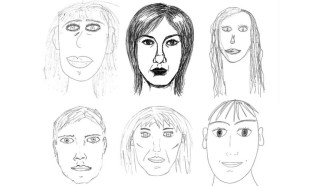
Why every face you draw looks a little Neandertal
Just about everyone draws faces with the eyes too high and a low Neandertal forehead, maybe because of the way we perceive the shape of the head.
- Paleontology
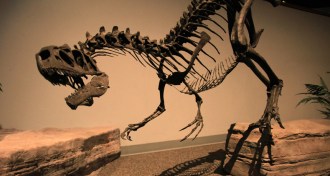
Dinosaurs could take tough breaks
Meat-eating dinosaurs may have survived some extremely bad bone breaks, according to detailed chemical maps of the fossils.
- Climate
Federal report details climate change in U.S.
The latest National Climate Assessment was released by federal officials May 6.
- Animals
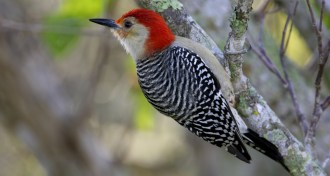
Woodpecker beaks divulge shock-absorbing properties
Scales, sutures and porosity help the birds hammer without going stupid.
- Animals
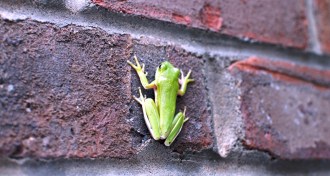
What animal is the world’s best rock climber?
Lots of animals manage to scale vertical heights, and each has their own way of accomplishing the feat.
- Math
The Improbability Principle
The laws of mathematics and physics suffice to explain a world of coincidences, statistician David J. Hand argues.
- Anthropology
Peruvian glyphs pointed way to ancient celebrations
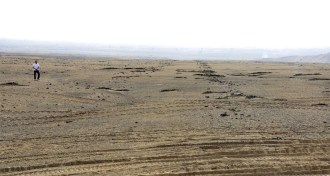
At least 2,300 years ago, Paracas people in the Chincha Valley of Peru were engineering their landscape to keep time and host ritual and social activities.
- Health & Medicine
U.S. patient with MERS virus is on the mend
A man in Indiana does not seem to have spread the potentially deadly respiratory illness.
- Health & Medicine
Massachusetts insurance mandate lowers death rate
Since “Romneycare” was phased in, mortality fell by 2.9 percent.
- Science & Society
Polls don’t identify the real science education problem
Concerns that Americans do poorly when quizzed on factual scientific knowledge don’t address deeper issues of scientific understanding.