All Stories
- Health & Medicine
Little jet-setters get jet lag too
Help young children fight jet lag with a few simple steps.
- Astronomy
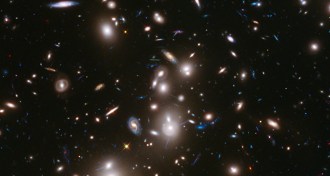
Faint, distant galaxies may have driven early universe makeover
Gravitational lensing has revealed extremely faint galaxies in the early universe, suggesting these tiny galaxies were responsible for cosmic reionization.
- Animals
‘Cannibalism’ chronicles grisly science of eating your own
In "Cannibalism", a zoologist explores a grisly topic that scientists have only recently begun to study seriously.
- Neuroscience
Artist’s amnesia could help unlock mysteries of memory
In "The Perpetual Now", journalist Michael Lemonick looks at what an artist’s memory loss can teach neuroscientists about the brain.
- Anthropology
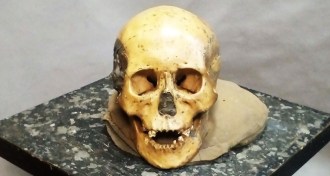
DNA points to millennia of stability in East Asian hunter-fisher population
Ancient hunter-gatherers in East Asia are remarkably similar, genetically, to modern people living in the area. Unlike what happened in Western Europe, this region might not have seen waves of farmers take over.
- Paleontology
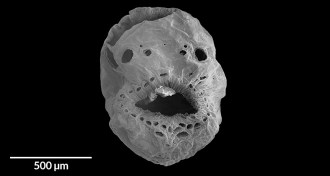
Pinhead-sized sea creature was a bag with a mouth
Dozens of tiny fossils discovered in 540-million-year-old limestone represent the earliest known deuterostomes, a diverse group of animals that includes humans and sea cucumbers.
- Genetics
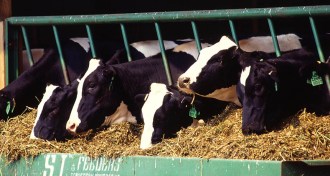
CRISPR used in cows to help fight tuberculosis
Chinese researchers used a CRISPR/Cas 9 gene editor to make cows more resistant to tuberculosis.
- Genetics
CRISPR used in cows to help fight tuberculosis
Chinese researchers used a CRISPR/Cas 9 gene editor to make cows more resistant to tuberculosis.
- Science & Society
Analysis finds gender bias in peer-reviewer picks
The peer-review process aims to avoid bias, but it turns out there’s gender bias in who is picked to review the papers.
- Archaeology
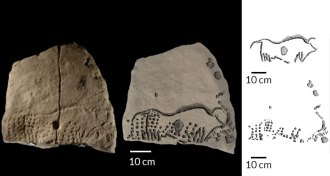
Cow carved in stone paints picture of Europe’s early human culture
Stone Age engraving helps to illuminate European travels of an ancient human culture.
- Oceans
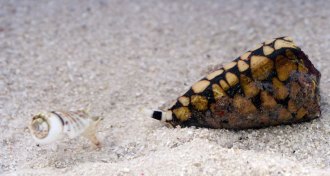
Cone snails wander in circles, lose focus with boosted CO2
Deadly cone snails wander in circles and become less capable hunters when exposed to higher levels of carbon dioxide in seawater.
- Oceans
Cone snails wander in circles, lose focus with boosted CO2
Deadly cone snails wander in circles and become less capable hunters when exposed to higher levels of carbon dioxide in seawater.