Uncategorized
- Earth
Bringing mammoths back, life on early Earth and more reader feedback
Readers debate the pros and cons of reviving extinct species, discuss the odd light-processing machinery of the eye and more.
- Neuroscience
Special Report: Dimensions of Time
Science News writers report on the latest scientific investigations into time’s place in the physical, biological and mental worlds.
- Science & Society
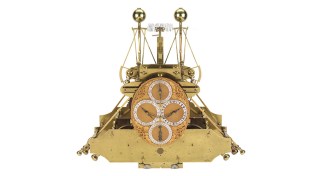
A brief history of timekeeping
For millennia, humans have harnessed the power of clocks to schedule prayers, guide ocean voyages and, lately, to chart the universe.
- Neuroscience
How the brain perceives time
To perceive time, the brain relies on internal clocks that precisely orchestrate movement, sensing, memories and learning.
- Genetics
Enormous quantities may soon be called ‘genomical’
Genetic data may soon reach beyond astronomical proportions.
- Paleontology
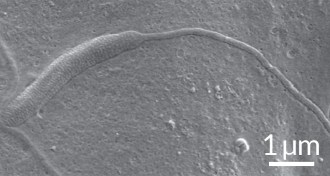
50-million-year-old fossil sperm discovered
Ancient worm sperm preserved in 50-million-year-old cocoons from Antarctica set age record.
- Particle Physics
LHC reports pentaquark sightings
Two particles discovered at the Large Hadron Collider are composed of five quarks, not two or three like nearly every other known quark-based particle.
- Life
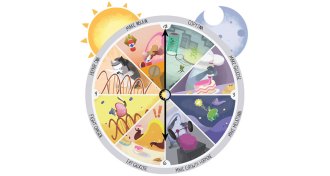
The origin of biological clocks
Most of Earth’s creatures keep time with the planet’s day/night cycle. Scientists are still debating how and why the circadian clocks that govern biological timekeeping evolved.
- Animals
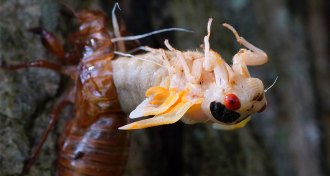
Some animals’ internal clocks follow a different drummer
Circadian clocks in some animals tick-tock to a different beat.
- Astronomy
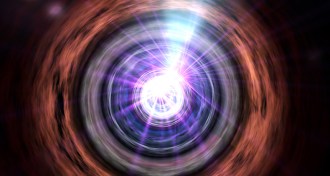
Source of blazars’ super brightness comes into focus
Astronomers take a close look at a blazar, a galaxy whose central black hole emits gamma rays and other high-energy material toward Earth.
- Anthropology
Tooth, jaw fossils tell tale of North America’s last nonhuman primates
Oregon fossils provide new clues to North America’s last nonhuman primates.
- Genetics
Genetic switch wipes out tumors in mice
By switching on a single gene, researchers turned cancer cells in mice back into normal intestinal tissue.