How tracking golden eagles in Nevada revealed a desert ‘death vortex’
The deaths are part of a larger population decline in the state
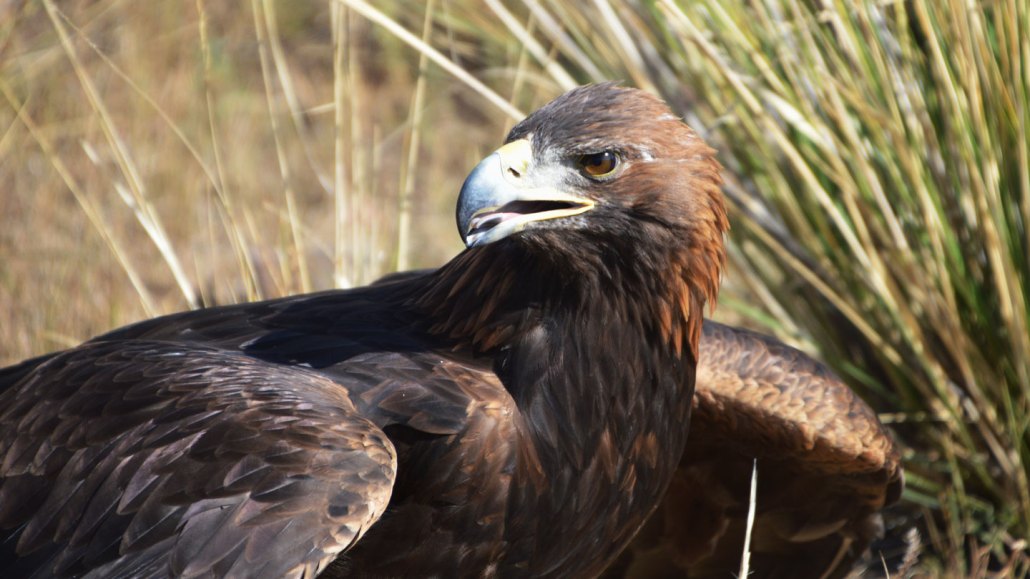
A multitude of threats, including a horrific rabbit disease, has sent Nevada’s golden eagle population numbers into a death spiral.
Joe Barnes
This is a human-written story voiced by AI. Got feedback? Take our survey . (See our AI policy here .)
Golden eagles in Nevada are dying at an alarming rate, and no one can pinpoint the cause.
Their carcasses litter the landscape in Dry Lake Valley, a bone-white stretch of parched earth north of Las Vegas that was a breeding ground for golden eagles, the largest bird of prey in North America. But now, new data suggest, the area has become a death vortex — a swirling black hole of deadly hazards threatening to swallow up the birds.
They can’t reproduce quickly enough to replenish their numbers. In ecological terms, that means the valley has become a population sink, says Joe Barnes, a Reno-based biologist with the U.S. Fish and Wildlife Service. These highly territorial raptors are flying in from neighboring regions to fill the void, he says, only to meet their demise as well.
And it’s part of a larger decline across the state. Though the number of golden eagles in Dry Lake Valley seems to be spiraling downward, until recently populations across Nevada were assumed to be stable. At last count, in 2017, they hovered around 3,000 individuals statewide. Based on the new data, however, Barnes estimates that we’ve lost ten percent of the population since 2014, with the potential for compounding losses in years to come, he fears.
“There’s a 2 percent chance that everyone is happy and healthy, but 98 percent odds that they’re declining, and it’s a fairly strong decline,” he says.
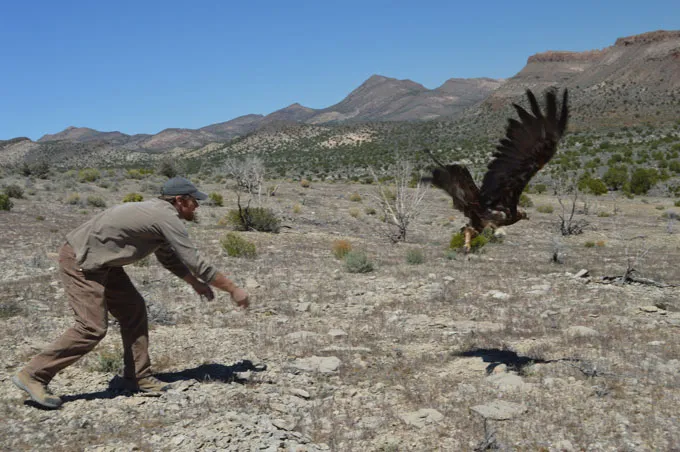
Tracking the state’s golden eagle population meant strapping transmitter-containing backpacks to every bird that Barnes’ team could capture. But these exceedingly wary, sharp-sighted creatures are no easy quarry.
“You’ve got to do it all under the cover of darkness,” Barnes says. “You don’t want to tip off the eagles. Everything’s got to be camouflaged.”
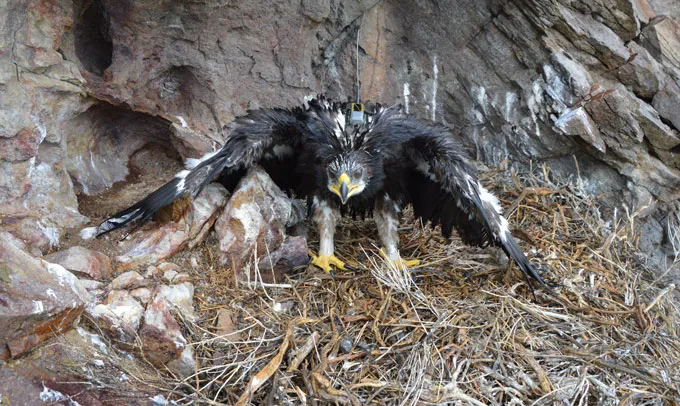
Rappelling into cliffside nests to tag chicks for future identification was another sort of adventure, one that James Golden, a wildlife researcher now at Colorado State University in Fort Collins, says required “guts.” “We get up this cliff, and the wind was just ripping,” Golden says. “We’re sitting there trying to figure out if it’s safe for the birds because they’re pretty young. And they’ll spread their wings as a defense to make themselves look big, and they’ll get blown right out of the nest.” In the end, the tagging didn’t hurt the eaglets.
Ultimately, Barnes and Golden tagged a number of chicks, and affixed transmitters to 43 adult golden eagles across Nevada (30 of which have since died, mostly by anthropogenic causes). These and other deaths, plus births and migrations, revealed declining numbers, says ecologist Perry Williams, a professor at the University of Nevada, Reno, who ran the population statistics.
The transmitters gave hourly snapshots of the eagles’ speed, direction, location, and altitude, allowing the researchers to identify 18 distinct golden eagle territories in Dry Lake Valley alone, which encircle it “like a necklace,” Barnes says. The data also helped them understand why the sink had been overlooked in wider population surveys, as they reported in the December Journal of Raptor Research.
Eagles are indistinguishable without transmitters, Barnes says. When one bird dies and its territory is taken over by another bird, the new occupant can be mistaken for the old one, so the loss isn’t accounted for. The tracking data made him realize, “holy cow, yes, they’re maintaining occupancy, but they’re obviously coming from somewhere else.”
There isn’t a clear reason for the overall population decline, but Barnes suspects it is tied to an increasingly hazardous environment in Nevada. Wildfire, drought, powerlines and lead pollution kill eagles. And over the last five years, many of the state’s birds have starved to death because a virus wiped out rabbits — their preferred prey.
All that stress may have caused Nevada’s golden eagles to stop breeding, Barnes says. “Eagles are unique in that they will take years off. So, if conditions are just awful… the female simply won’t lay eggs that year. And sometimes it’ll be multiple years, half a decade.”
What’s more, the construction of solar energy fields across Nevada (and the wider U.S. Southwest) is degrading eagle habitat. “What scares me is that this type of land conversion, if you don’t do it wisely, can have really serious local impacts to wildlife and ecology,” Barnes says.
Developers have proposed a 104-square-kilometer solar energy field in Dry Lake Valley, though after more than 10 years, it has yet to break ground. If and when work begins, Barnes hopes it’s done in a way that doesn’t disturb the eagles.
Barnes was out there again in late January collecting data, checking to see if the birds are breeding and what they are eating. Despite virtually no courtship behavior, “very low jackrabbit numbers, poor vegetation growth and extremely dry conditions,” he says, the eagles persist — for now.