Rare Uranian eclipse
The Hubble Space Telescope has for the first time recorded an eclipse on Uranus. The white dot is Uranus’ moon Ariel, which is 1,120 kilometers wide.
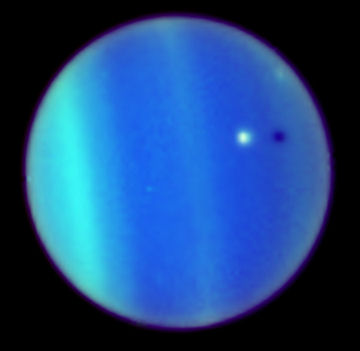
By blocking the sun, it casts a shadow (black dot to right) on the planet’s cloud tops.
Although eclipses frequently occur on Jupiter and Saturn, Uranus rotates tipped on its side, so the sun alternately shines on one pole or the other during the planet’s 84-year orbit. Because the moons of Uranus orbit at the planet’s equator, the sun seldom illuminates them directly. During the last equinox on Uranus, in 1965, no telescope was sharp enough to record an eclipse.
As Uranus approaches its 2007 equinox, astronomers expect Hubble’s sharp eye to record many more eclipses by the planet’s retinue of satellites.