THE WOODLANDS, Texas — The sky is falling on Titan. An upper layer of the Saturnian moon’s hazy shroud has plunged more than 100 kilometers since the Cassini spacecraft whizzed by in 2004, suggesting that shifting seasons can do more than dump rain.
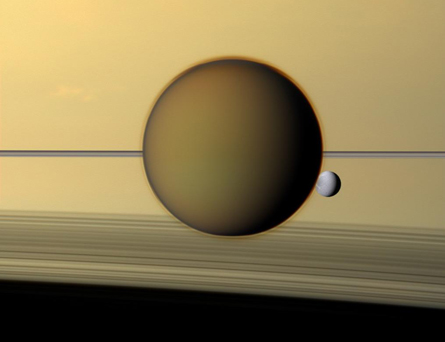
Early Cassini images revealed a smoggy world circled by a detached, hazy layer that hovered 500 kilometers above the moon’s surface. Now, new images reveal, that layer has sunk to an altitude of around 360 kilometers, said Robert West of the Jet Propulsion Laboratory in Pasadena, Calif., on March 19 at the 43rd Lunar and Planetary Science Conference.
The layer’s current altitude almost precisely matches the haze’s position in 1981, when the Voyager spacecraft recorded images of Titan hiding beneath the clouds. “To me, that’s just astonishing,” said West.
One year on Titan is the equivalent of nearly 30 years on Earth — and now, one Titan year after Voyager, the moon looks more or less as it did in 1981. When Cassini first swung by in 2004, the haze had ballooned outward and covered the entire moon except for the wintry north pole vortex. Now, as winter comes to the south, the haze is shrinking, and images snapped by Cassini in late February reveal the beginnings of a vortex at the south pole.
“It’s really spectacular,” said planetary scientist John Spencer of the Southwest Research Institute in Boulder, Colo. “You’re seeing this world changing before your eyes, and there are all these totally unexpected, very dramatic patterns that show up. You just can’t wait to see what’s going to happen next.”
Scientists suspect that shifting seasons are accompanied by changing atmospheric patterns, and the collapsing haze layer could be one of a constellation of seasonal cycles. But so far, researchers haven’t been able to explain the mechanics of the falling haze.
“This is new; we’re seeing it for the first time with Cassini,” West says. “We’ll see within the next couple of years how this evolves.”