Space
We summarize the week's scientific breakthroughs every Thursday.
-
- Planetary Science
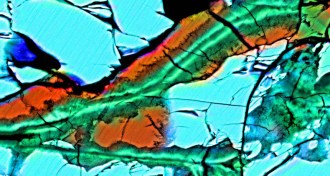
Carbonation may have grounded Mars’ atmosphere
The chemical interaction could have forced Red Planet’s atmospheric carbon dioxide into the dirt.
- Environment
Feedback
Readers respond to "Solving soot," trade-offs of horn size for male Soay sheep and the huge galactic explosion story from 50 years ago.
- Planetary Science
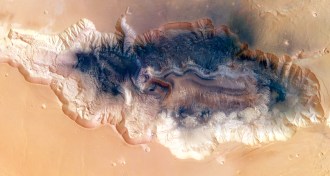
A grander canyon on Mars
Hebes Chasma, a huge trough on Mars, reflects the Red Planet’s tumultuous and varied past.
- Astronomy
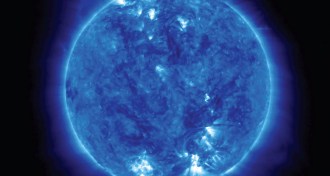
Quiet maximum
By almost any measure, this solar maximum has been pathetic. No more than 67 sunspots have appeared in a month so far; at the last peak, in 2000, that number was above 120.
-
- Astronomy
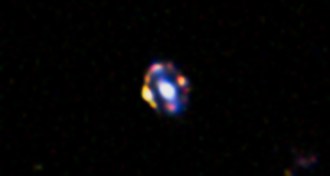
Most distant galaxy lens discovered
Astronomers have discovered a galaxy about 9.4 billion light-years from Earth that is magnifying the light of an even more distant galaxy. It’s the most distant gravitational lens found to date.
- Astronomy
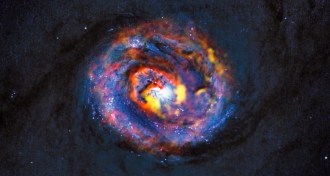
Galaxy’s gas molecules reveal its structure
Astronomers have tracked carbon monoxide flowing both toward and away from NGC 1433’s central supermassive black hole.
- Astronomy
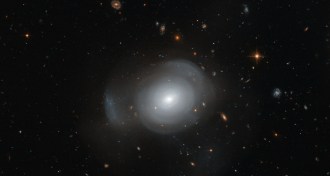
Galaxy’s petal-like structures came from collision
A cosmic crash of two huge masses of stars, gas and dust probably gave way to a new galactic structure with both young and old star clusters.
- Astronomy
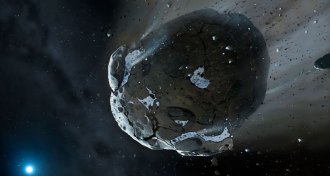
Water seen in rubble around star
Hubble sees debris that was part of an asteroid with the ingredients for habitable planets.
-
-