Space
We summarize the week's scientific breakthroughs every Thursday.
- Planetary Science
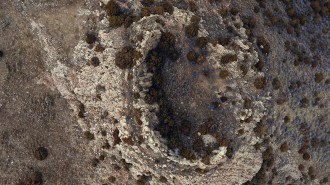
An ancient impact on Earth led to a cascade of cratering
For the first time, scientists have discovered clusters of craters on Earth that were formed by the impacts of material thrown out of a larger crater.
- Astronomy
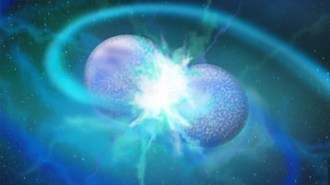
A rare collision of dead stars can bring a new one to life
These carbon- and oxygen-covered stars may have formed from an unusual merging of two white dwarfs.
- Computing
Core memory weavers and Navajo women made the Apollo missions possible
The stories of the women who assembled integrated circuits and wove core memory for the Apollo missions remain largely unknown.
- Astronomy
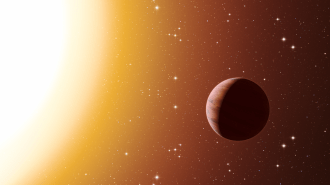
How ‘hot Jupiters’ may get their weirdly tight orbits
Gravitational kicks from other planets and stars can send giant worlds into orbits that bring them close to their suns.
- Planetary Science
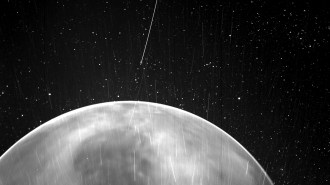
These are the first visible-light images of Venus’ surface captured from space
Cameras aboard NASA’s Parker Solar Probe managed to peer through Venus’ thick clouds to photograph the planet’s surface.
- Planetary Science
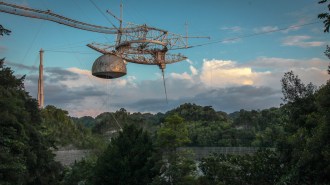
50 years ago, Arecibo got an unprecedented view of Venus’ surface
Over its 57-year lifetime, Arecibo’s radar system measured the mountains around Venus’ middle, studied the textures of many rocky bodies in outer space and more.
- Space
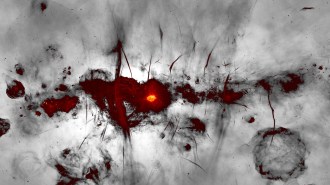
The heart of the Milky Way looks like contemporary art in this new radio image
The MeerKAT telescope array in South Africa provided this image of radio emissions from the center of our galaxy using data taken over three years.
- Planetary Science
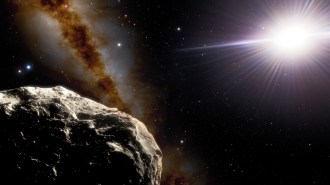
Earth has a second known ‘Trojan asteroid’ that shares its orbit
A recently found space rock is about one kilometer wide, orbits ahead of Earth around the sun and will stick around for at least 4,000 years.
- Planetary Science
Machine learning points to prime places in Antarctica to find meteorites
Using data on how ice moves across Antarctica, researchers identified more than 600 spots where space rocks may gather on the southern continent.
- Astronomy
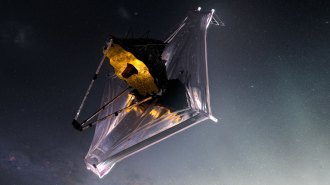
The James Webb Space Telescope has reached its new home at last
The most powerful telescope ever launched still has a long to-do list before it can start doing science.
- Astronomy
An X-ray glow suggests black holes or neutron stars fuel weird cosmic ‘cows’
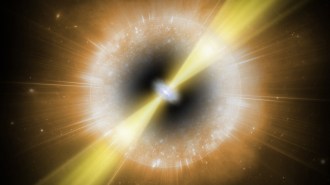
With the brightest X-ray glow of a new class of exploding stars, cosmic oddity AT2020mrf boosts evidence of these mysterious blasts’ power source.
- Space
50 years ago, NASA’s space shuttle program got the green light
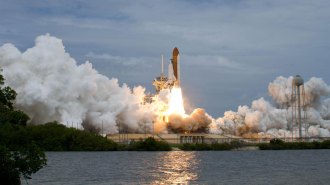
For over 30 years, space shuttles helped revolutionize science. Now, NASA is tackling new frontiers with help from commercial spaceflight companies.