All Stories
- Planetary Science
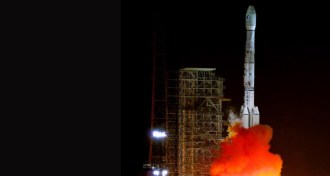
China’s first moon-landing mission blasts off
If successful, the Chang’e 3 lunar lander and Yutu rover will be the first spacecraft to land on the moon in 37 years.
-
- Earth
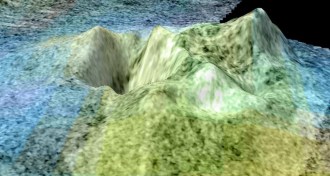
Cryovolcano
An ice volcano that erupts slurries of volatile compounds such as water or methane instead of lava.
- Neuroscience
Fear can be inherited
Parents’ and even grandparents’ experiences echo in offspring, a study of mice finds.
- Planetary Science
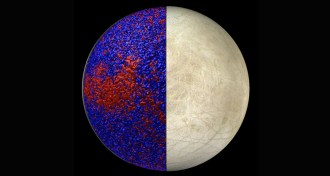
Turbulent ocean could explain Europa’s chaotic ice
New computer simulations show turbulent global ocean currents that distribute heat unevenly and could explain the formation of the chaotic ice patterns at the moon’s lower latitudes.
- Computing
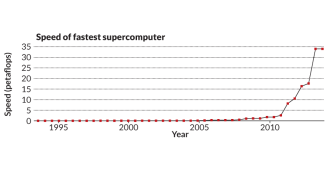
Fastest supercomputers
The new list of the world’s fastest computers, now in its 20th year, has China’s Tianhe-2 on top with a processing speed of 33.9 petaflops — or quadrillions of calculations per second.
- Particle Physics
Higgs boson tale wins book prize
The Particle at the End of the Universe by Sean Carroll.
- Health & Medicine
Cancer vaccine in near future foreseen
Excerpt from the December 21, 1963 issue of SCIENCE NEWS LETTER.
-
- Science & Society
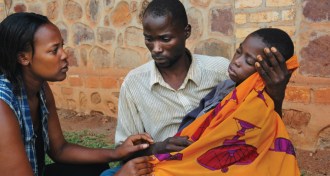
Heal thy neighbor
As antidepressants and other drugs gradually replace psychotherapy in the United States, new forms of the talking cure are growing in popularity in developing countries ravaged by civil war and poverty.
- Astronomy
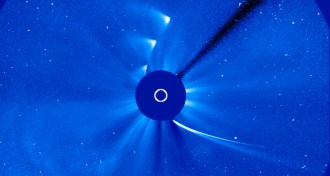
ISON seems to have survived close call with sun
Comet ISON seems to have emerged from its brush with the sun diminished but intact, according to the latest reports.
- Neuroscience
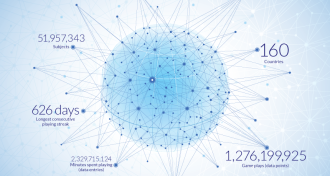
Global neuro lab
With more than 50 million users, the brain-training website Lumosity is giving scientists access to an enormous collection of cognitive performance data. Mining the dataset could be the first step toward a new kind of neuroscience.