Uncategorized
- Neuroscience
Areas people like to be caressed match up with nerve fibers
A caress in a sweet spot at the right speed activates nerve fibers tied to social touch.
- Planetary Science
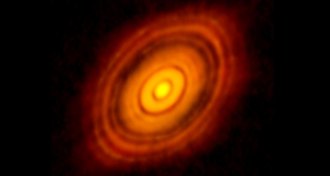
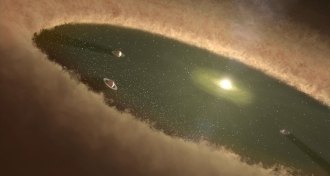
Planets stake their claim around infant star
At the center of the newly released telescope image is HL Tau, a star located about 450 light-years away in the constellation Taurus. A dense disk of gas and dust surrounds the star, which is a youthful million years old.
- Life
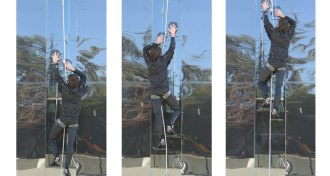
Springs bring gecko stickiness to human scale
Springs of a stretchy alloy let gecko-inspired adhesives work at human scales to climb glass walls or grab space junk.
- Neuroscience
Protein production prevents sleep-loss forgetfulness
Boosting levels of certain proteins in mice prevented memory problems associated with sleep deprivation.
- Health & Medicine
Aspirin’s heart benefits not a slam dunk
No survival gain found in people age 60 and over who took daily dose of aspirin.
- Psychology
Right questions could help spot devious air passengers
Training airport security agents to ask detail-oriented questions of travelers may help unmask liars.
- Neuroscience
Mold may mean bad news for the brain
Living with mold isn’t good for your lungs. A study in mice shows that mold exposure may also cause inflammation that is bad for the brain.
- Planetary Science
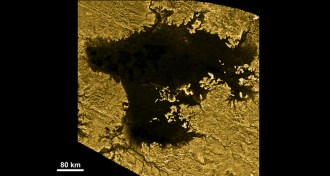
Cassini maps depths of Titan’s seas
NASA’s Cassini spacecraft finds that some methane seas on Titan extend more than 200 meters beneath the Saturnian moon’s surface.
- Environment
DDT lingers in Michigan town
Decades after a plant manufacturing DDT shut down in Michigan, the harmful insecticide is still found in neighboring birds and eggs.
- Neuroscience
‘Bath salts’ reduce communication in rat brains
The recreational drugs known as bath salts cause a loss of communication between areas in the rat brain.
- Life
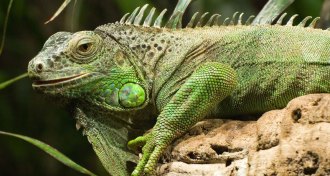
Iguanas’ one-way airflow undermines usual view of lung evolution
Simple-looking structures create sophisticated one-way air flow in iguana lungs, undermining old scenarios of lung evolution.
- Planetary Science
Unseen planets sweep up dust around young star
A large gap in the dusty disk around a young star reveals what our solar system might have looked like 4.6 billion years ago.