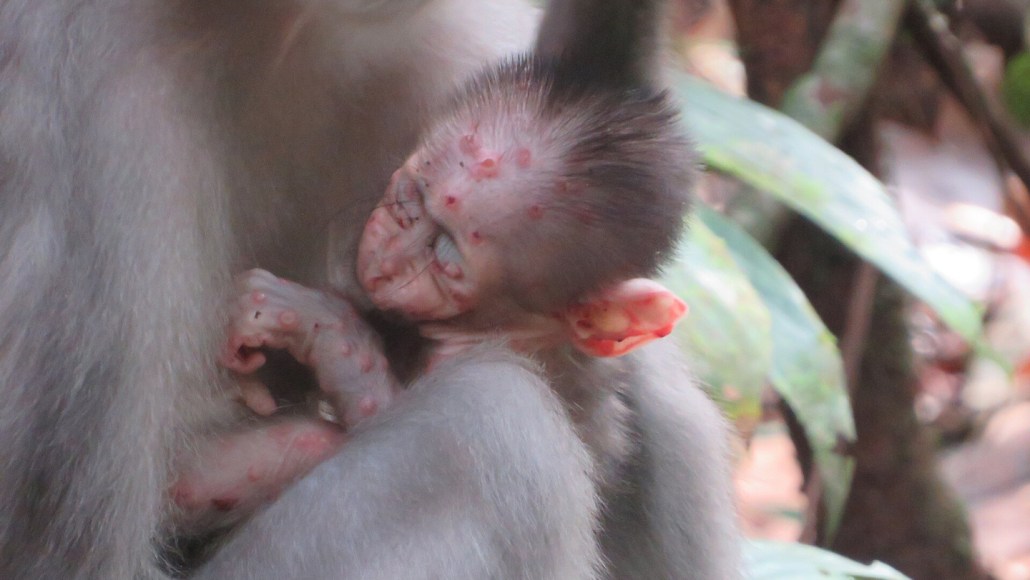
In 2023, an outbreak of mpox erupted among a group of sooty mangabeys (Cercocebus atys) in Côte d’Ivoire’s Taï National Park. Roughly a third of the group, including infants (one shown) fell ill. A new study suggests a fire-footed rope squirrel eaten by one of the monkeys may have been the source.
Taï Chimpanzee Project, Carme Riutord-Fe/HIOH
A monkey making a meal of a squirrel may have sparked an outbreak.
In early 2023, mpox broke out among a group of a few dozen sooty mangabeys (Cercocebus atys) living in Côte d’Ivoire’s Taï National Park. Roughly one-third of the monkeys developed symptoms such as skin lesions and four infants died. Surveys of the park’s wildlife revealed that the outbreak began after a member of the group ate a fire-footed rope squirrel (Funisciurus pyrropus), researchers report February 11 in Nature.
The findings suggest a rope squirrel was the source of the outbreak and for the first time show the monkeypox virus jumping from one species to another in the wild. Viral spillovers from animals to people are typically at the root of human mpox outbreaks.
Pinpointing which animals carry the virus can help guide prevention measures that protect people from getting infected, says Clement Meseko, a veterinarian and virologist at the National Veterinary Research Institute in Vom, Nigeria who was not involved in the work. Officials might tell people who live or work around fire-footed squirrels to wear personal protective equipment when handling squirrels, for instance, or to wash their hands.
Several mpox outbreaks have popped up among Taï National Park’s primates since 2012, says Livia Patrono, a veterinarian and disease ecologist at Helmholtz Institute for One Health in Greifswald, Germany. In 2012, an infected sooty mangabey turned up dead. Then members of three separate groups of chimpanzees (Pan troglodytes) fell ill in 2017 and 2018. But primates weren’t themselves harboring the virus. Researchers only ever saw mpox circulating in primates during outbreaks, not before or after.
“One big question for us has been, ‘where are the nonhuman primates getting infected from?’” Patrono says. That’s why for years she and colleagues have been testing rodents in the park.
African rodents including rope squirrels are among the leading suspects for mpox reservoir hosts — species in which the virus permanently circulates. The first monkeypox virus isolated from wildlife came from a Thomas’s rope squirrel (F. anerythrus), and multiple squirrel habitats overlap with spots where human epidemics have begun. Rope squirrel museum specimens from as far back as 1899 have tested positive for the virus.
Extensive wildlife monitoring including testing fecal samples found throughout the park and conducting necropsies of dead animals allowed Patrono and colleagues to scrutinize how the 2023 mpox outbreak took off. The team tested more than 700 trapped or dead rodents for monkeypox virus. Just one tested positive: a fire-footed rope squirrel found dead 3 kilometers south of the sooty mangabeys’ territory and only 12 weeks before the outbreak began.
Genetic analyses of the squirrel virus and the version that sickened sooty mangabeys showed that the viruses were closely related but not identical. The finding suggests that while the dead squirrel didn’t spark an epidemic, another might have.
Mangabeys do chow down on small mammals, and video evidence from 2014 showed one of the park’s mangabeys eating a fire-footed rope squirrel. To find out if squirrel was recently on the menu, the team tested mangabey fecal samples collected before the outbreak for rope squirrel DNA. Two samples showed signs of a fire-footed squirrel meal. One of those samples also tested positive for monkeypox virus and came from the monkey believed to be the first to get infected.
“That was a pretty, let’s say, informative piece of evidence saying that [a fire-footed rope squirrel] was a very likely source of infection for the mangabeys,” Patrono says. Other rodents also likely carry the virus in the wild, meaning additional species may also pose a threat.