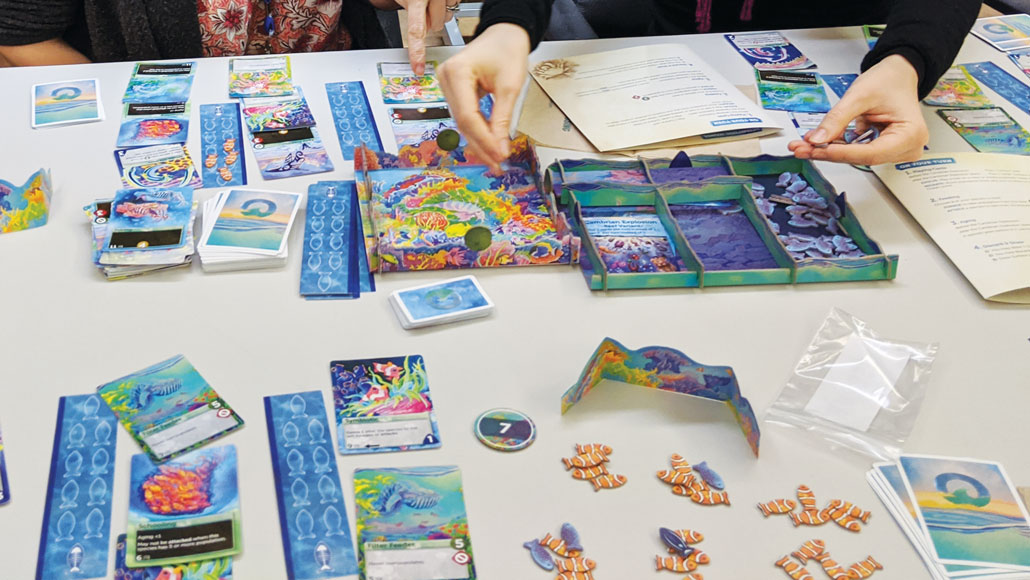
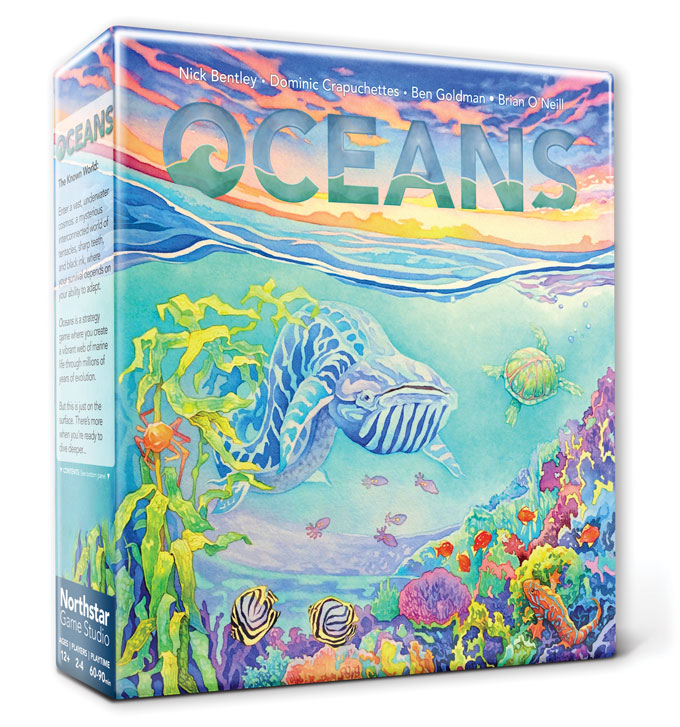
Oceans is an immersive strategy board game in which players create marine species and earn points by keeping those species healthy.
M. Denison
Maybe somewhere there’s an ocean where the transparent parasite Invisy McSuckFace is scrounging for its next meal. The bloodsucker might have to flee from the terrifyingly fast swordfish-shark hybrid Zoomy killa or dodge dozens of tentacles from schools of the octopus-like Grabbo clique. But more likely, these critters exist only in Oceans, a strategy board game by North Star Games that masterfully translates the wonders and complexities of marine ecology to a tabletop setting.
The game, on sale this spring, is a sequel to North Star’s popular Evolution game, and the core experience is similar. Two to four players — or in some editions of the game, six — vie to keep species alive and well-fed, with acquired food ultimately converted into points. On each turn, a player deploys a trait card to create a new species or grant new abilities to existing ones. These traits, such as “apex predator” or “filter feeder,” correspond to skills and physical features that help real marine critters survive and find food. Some species may be reef foragers, for example, while others are more aggressive, stealing food from other species.
Building a roster of creatures that interact well with each other or with other players’ species in the ecosystem is essential to achieving victory. And in that way, the game mimics real evolutionary pressures, with players responding to the dominant sea creature and finding new ways to tap into the oceans’ bounty. Is an apex predator taking over the seas? Keep your prized species safe by employing a squid’s trusty defense tactic — shooting ink at an enemy — or take advantage of the predator’s prowess by eating the animal’s scraps.
As the game progresses, randomly selected scenarios can alter the game dynamics, incentivizing players to adapt to a shifting environment. For example, the “fertile” scenario rewards players for creating many new species, while the “epizootic” event simulates a disease outbreak by cutting down populations of some species.
Just as players think they have the ecosystem figured out, the Cambrian explosion hits. For the rest of the game, players use two traits per turn and can access the “Deep” deck, full of the most bizarre characteristics of marine life and mythical sea creatures. “Oceans is really exploring this space between the known world, what science knows, and the unknown,” says lead designer Dominic Crapuchettes. While Deep cards cost points to play initially, the benefits of becoming a fearsome kraken or a whale that has mastered bubble nets to corral prey (SN: 11/9/19, p. 7) are often worth the gamble.
We summarize the week's scientific breakthroughs every Thursday.
North Star consulted marine biologist Brian O’Neill of the University of Wisconsin–Whitewater in the design of the game, and the scientific background pays off in a cohesive and (mostly) scientifically accurate experience. For instance, the Cambrian explosion ushers in a burst of rapid evolution and biodiversity, much like the real-life event about 541 million years ago (SN: 4/27/19, p. 14). And a species’s traits usually interact in ways that make biological sense: “Inking” and “schooling” both make a creature harder to attack, and “speed” gives aggressive species a boost.
But that’s not always the case. “The thing I’m struggling with is giving things biological traits that don’t make any sense,” earth and climate writer Carolyn Gramling noted when Science News staffers tried the game. For example, it’s possible to create a species that is both parasitic and symbiotic with the same creature, or even an apex predator that’s also a filter feeder, though that may be as questionable strategically as it is biologically.
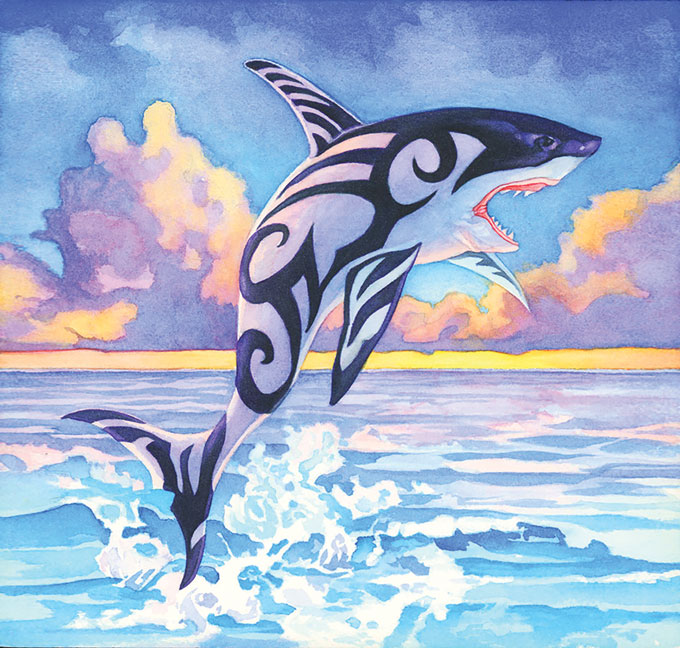
Scientific quibbles aside, Oceans excels at evoking a sense of wonder. The striking watercolor art by illustrator Catherine Hamilton, on the game board and many of the trait cards, invites players into a vibrant ecosystem. The game rewards both careful planning and quick thinking, which prevents the frustrating feeling of dreading a certain loss after an early mistake (a common occurrence in Oceans’ predecessor, Evolution). And there’s a welcome dash of humor: Reading the in-game guide to scientific names resulted in Science News staffers developing creative names for their species, including Invisy McSuckFace.
Those familiar with Evolution will feel right at home in Oceans’ less punishing but equally nuanced gameplay. And for those who are new to strategy games, Oceans is a good introduction: It’s intuitive enough to pick up the basics after a few turns, but nuanced enough to be enjoyable after dozens of games. As players battle for survival, they’ll soon find that the ocean is, as Science News staff writer Jonathan Lambert put it, “red in tooth and tentacle.”