This new year, maybe resolve to quit
Quitting old goals frees up space for new ones

By Sujata Gupta
Social Sciences Writer
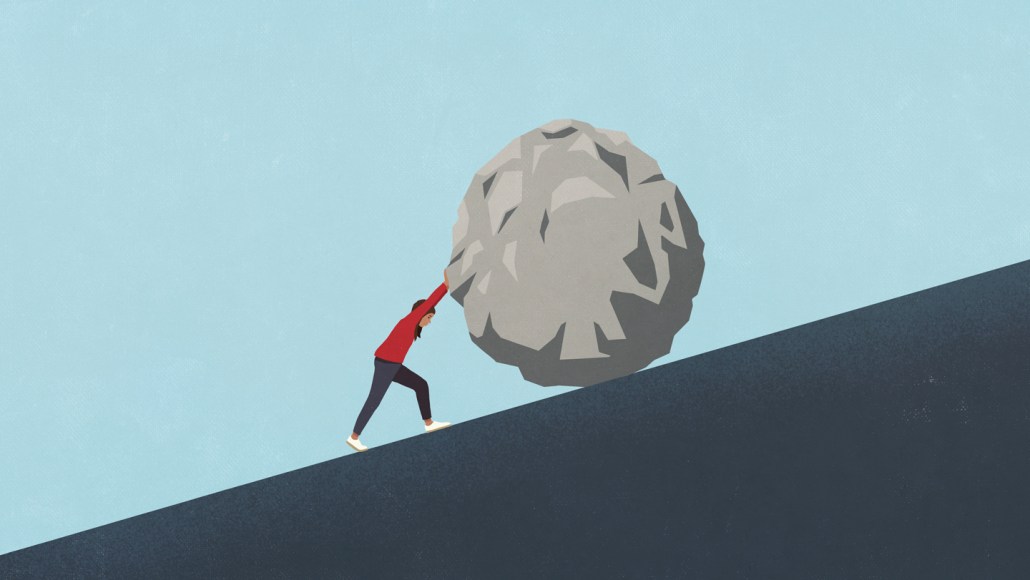
Most stories in the West emphasize persevering, often against all odds. But sometimes quitting is the best path forward.
Malte Mueller/Getty Images
This is a human-written story voiced by AI. Got feedback? Take our survey . (See our AI policy here .)
In the classic American folktale The Little Engine That Could, a small blue locomotive laboriously chugs up a hill hauling cars stuffed full of toys and food for children on the other side. The train engine wills herself up the steep incline by chanting: “I think I can, I think I can, I think I can.”
Stories of sticking things out, often under the most trying circumstances, dominate Western society and, by extension, psychological literature, says Andreea Gavrila, a psychological expert at Université du Québec à Montréal in Canada. “We value perseverance and persistence.”
But this new year, instead of setting resolutions to lose weight, find true love, change careers or jump out of an airplane, Gavrila and others suggest that some people consider the opposite. “It’s time to reassess at the end of the year, ‘What is something I don’t need in my life anymore?’” says computational cognitive scientist Rachit Dubey of the University of California, Los Angeles.
When goals become too financially or emotionally costly or discordant with where one is in life, they can trigger physical and mental health problems, considerable research shows. And though quitting may have a bum reputation, letting go can be harder than persevering, especially when the goal is tethered to one’s identity.
Compared with research into persevering, the quitting literature is relatively new, and insights into just when and how to quit a goal remain nascent. What is known is that quitting a goal can take months or even years, Gavrila says. “Think of a relationship. There’s a difference between breaking up with someone and moving on from someone.”
Letting go, in other words, can be messy and painful. But when one truly relinquishes a long-held pursuit, they free up the mental bandwidth for new goals and dreams.
Hardwired to hate sunk costs
Researchers who study quitting aren’t arguing that giving up is always the best option. “It’s in human nature to set goals because goals give us direction. Goals represent some desired future end state,” says Nikos Ntoumanis, a motivation science expert at the University of Southern Denmark in Odense. The best outcome is when a goal becomes habitual and therefore requires very little willpower. For instance, someone may set a goal to start exercising. They achieve that goal when exercise has become a routine part of their life.
Sometimes, though, striving toward a goal is such a struggle that it creates undue guilt and stress. That’s why Ntoumanis and others want people to recognize that a tendency toward perseverance no matter what may obscure other, better options.
For instance, Dubey and his team had more than 3,500 participants play a simple online game in which they had 100 chances to push a button of a given color. Sometimes the push delivered a point, sometimes not. Unbeknownst to the participants, some buttons had higher odds of delivering points than others. At any time, participants could request a new button color to see if they could snag more points. To mirror real life, in which going back on a decision is often impossible, participants could not return to a previous color. The team then developed a mathematical formula to quantify a player’s optimal strategy.
While playing the game, people stuck with a given color well beyond what was optimal, the team reported in September in the Journal of Experimental Psychology: General. Participants also explored relatively few buttons before settling on a final color.
It’s striking that even in this simplistic setup, where the stakes are essentially nil, people still struggled to explore widely and quit with ease, Dubey says. He suspects that in real-life settings, where the emotional stakes are likely higher, people are even more reluctant to give up.
That’s why Dubey often advises people to take a hard look at their goals.
“If something is consistently disappointing you, maybe try to get the emotions out of it and … be more ruthless to quit,” he says.
Quitting, though, can feel unnatural, research shows. Humans and even other animals, such as birds and rodents, are prone to the sunk-cost bias, or an aversion to quitting goals, particularly those in which they have invested significant energy, time or money.
Susceptibility to the sunk-cost bias may be hardwired, according to research on patients with a specific type of brain damage. People with damaged ventromedial prefrontal cortices, or vmPFCs, tend to inhabit a sort of eternal present. So researchers in the United Kingdom wanted to see if their pursuit of goals — which, by design, are anchored in the future — differs from those without this type of brain damage.
The team had 23 people with damaged vmPFCs and 30 people without brain damage play a video game inside an MRI machine. The goal of the game, which took place across several rounds, was to fill a virtual net with as much seafood as possible. The hitch? Participants could fill the net with only one type of seafood: octopus, crab or fish. Quantities of each seafood differed across the rounds, with occasional drastic changes. Before each round, individuals could choose to stick with their current option or abandon one seafood goal and start over with another.
Compared with nonbrain-damaged individuals, people with damaged vmPFCs were more likely to abandon a given seafood type once another seafood type became the clear winner, the team reported in July 2024 in Nature Human Behaviour.
People with this type of brain damage played more rationally and were thus more likely to win the game. But in real life, that tendency to give up as soon as the going gets tough can make life incredibly hard for such individuals. These people are often cognitively strong, but they can struggle in their daily lives, such as holding down a job, says Eleanor Holton, a cognitive neuroscientist now at Princeton University. “They cannot structure the future. It’s a jumbled mess.”
Letting go of goals can thrust people without vmPFC damage into a similarly jumbled state, say Holton and others. It’s hard to dismantle our long-held visions for the future. But sometimes it’s necessary, and researchers are still sorting out how to help people work through that difficult process.
Motivation from within
Ironically, the same tools that help people persevere may also help them quit, some research suggests. For instance, goal researchers have long spoken of action crises, or points at which people vacillate between wanting to quit a goal or stay the course. A key indicator for whether a person will stick it out has to do with what is motivating them to change.
Consider two people who want to lose 10 pounds, Ntoumanis says. One person is doing it because they want family members to stop haranguing them about the extra weight. That message of guilt and shame seldom leads to long-term changes. But another person might want to shed pounds to feel healthier. That inner drive can lessen or ward off an action crisis.
More recently, researchers have been looking at whether an inner resolve to quit can similarly ward off an inaction crisis, or questioning a decision to quit long after the fact.
During an inaction crisis, a person wants to disengage, but they’re stuck, Gavrila says. A person who quit an ill-fitting graduate program, for instance, may question their decision as they struggle to identify what’s next. Or a person who has broken up with a long-term partner may continue to follow their ex’s every move on social media.
To see how well people move on from goals in real life, researchers periodically surveyed more than 500 students at a university for nine months and more than 400 individuals from a community sample for three months. At the start of the study, the team asked participants about a long-term goal they were abandoning and how important the goal was to their lives. They had participants rate statements, such as, “This goal no longer reflects who I am,” to assess inner drive and “People have been telling me I have to let this goal go” to assess external pressures to quit.
As the study progressed, the team assessed how far along participants were in disengaging from their goal. They also gauged whether a person was experiencing an inaction crisis by having them rate statements, such as “I feel torn about letting go of this goal.”
Participants across both samples who reported that they were quitting a goal primarily due to external pressures tended to get more stuck in inaction crises than those who reported more interior motives, the team reported in December 2022 in Motivation and Emotion.
People don’t tend to wake up one day and say, “I’m done” and seamlessly move on to their next great life adventure. “There’s all this difficulty in letting go of the goal,” says Gavrila, who was not involved in that study. “It’s very messy.”
Researchers are still working out the particulars of when people ought to let go of a goal, the best ways to go about the process and, ultimately, how to develop new goals for the future. Some suspect that the clues to helping people let go may lie in other social subfields, such as research into acceptance or overcoming grief.
Filling the void left by a relinquished goal remains an even less developed area of research, researchers write in the 2022 Annual Review of Psychology. Initial evidence suggests that helping people work on their mood, greater sense of purpose and overall life satisfaction can help.
What is clear is that, if a goal has run its course, clinging to it can do more harm than good. And finding a new path forward may first require the courage to say, “I think I can’t.”