A humble metallic powder made headlines last year when Japanese researchers found it to be a superconductor–a material in which electric current flows resistancefree (SN: 3/3/01, p. 134: Run-of-the-mill compound becomes superstar). Most remarkable–and inexplicable–was how warm the compound, magnesium diboride, could get before its superconductivity disappeared.
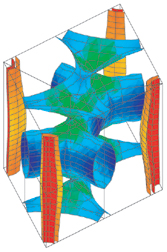
Now, Hyoung Joon Choi and his colleagues at the University of California, Berkeley and Lawrence Berkeley (Calif.) National Laboratory explain the superconductor’s exceptionally high transition temperature of 39 kelvins, as well as other puzzling properties of the material. So-called conventional superconductors, of which magnesium diboride is a member, typically become superconductors below 20 kelvins.
The new calculations show in detail what other theorists previously sketched: that magnesium diboride contains two distinct families of electron pairs, one in which the electrons are weakly coupled and one in which they’re strongly joined. No other superconductor has ever shown evidence of more than one type of electron pairing.
In conventional superconductors, vibrations of atoms induce electrons, which normally repel each other, to form pairs. Hitched together, those electrons move through the crystal lattice unimpeded.
Magnesium diboride’s superconducting properties turn out to be a compromise between the effects of the two electron-pair families. By including both, the new calculations correctly predict the compound’s transition temperature and how heating affects the material. The findings, reported in the Aug. 15 Nature, may lead investigators to other novel superconductors with higher transition temperatures, the scientists say.