787 results
787 results for: Mammoths
- Paleontology
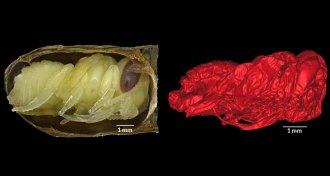
La Brea Tar Pits yield exquisite Ice Age bees
Ancient bee pupae snug in leafy nest give clues to Pleistocene climate.
- Humans
Neandertal mitochondrial DNA deciphered
Researchers have completed a mitochondrial genome sequence from a Neandertal. DNA taken from a 38,000-year-old bone indicates that humans and Neandertals diverged 660,000 years ago and are distinct groups.
- Life
Humans aided, constrained by fossil fuels
Maintaining long-term population will require alternate energy sources.
- Space
Tiny object points to remote solar system reservoir
Possible comet may be distant visitor from the innermost region of the Oort Cloud, the proposed comet reservoir of the outermost solar system.
- Earth
Mammoth migrations
Ancient DNA shows North American woolly mammoths migrated back to Asia and displaced Siberian mammoths.
- Humans
Stone Age seafood fans
Excavations in two Gibraltar caves suggest that Neandertals, like modern humans, regularly visited the Mediterranean shore to complement a land-based diet with seafood
-
-
- Humans
DNA unveils enigmatic Denisovans
Technical advances amplify the genetic record of a Stone Age humanlike population, ancestors of modern Melanesians.
- Life
Team releases sequel to the human genome
ENCODE reveals the machinery that switches genes on and off.
- Chemistry
Human blood types have deep evolutionary roots
The ABO system may date back 20 million years or more, a genetic analysis suggests.
- Humans
Neandertals’ mammoth building project
Stone Age people’s evolutionary cousins may have constructed earliest bone structures.