Predicting the geometric shapes of soap bubble clusters can lead to surprisingly difficult mathematical problems.
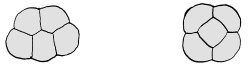
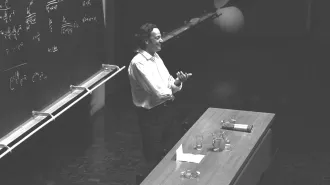
Frank Morgan of Williams College in Williamstown, Mass., recently illustrated such difficulties when he invited an audience of mathematicians, students, and others to vote on which one of a given pair of different representations of the same number of clustered planar bubbles would have a smaller total perimeter. Assembled for a ceremony at the National Academy of Sciences in Washington, D.C., to honor the 12 winners of the 2001 U.S.A. Mathematical Olympiad (USAMO), audience members were wrong as often as they were right.
“These are very tricky questions,” Morgan says. “You often can’t even come up with reasonable conjectures.”
Even the case when two bubbles join to form a double bubble–a sight familiar to any soap-bubble aficionado–has posed problems for mathematicians. In this case, the two bubbles share a disk-shaped wall, and this divider meets the individual bubbles’ walls at an angle of 120 degrees. Mathematicians call this configuration the standard double bubble. If the bubbles are of equal size, the interface is flat. If one bubble is larger than the other, the rounded surface of the boundary film bulges into the bigger bubble.
Soap bubbles naturally assume the standard double bubble configuration. However, this geometric structure isnt the only candidate for the most economical way of packaging a pair of volumes. For instance, one bubble may ring the other–like an inner tube fitting snugly around a peanuts waist–to form a two-chambered torus bubble (see http://www.math.uiuc.edu/~jms/Images/double/).
Mathematicians have long known that the circle is the shortest way to enclose a given area and that the sphere is the most economical way to enclose a given volume. “The double bubble, however, was long neglected: classical mathematics preferred smooth surfaces, not pieces of surfaces meeting at angles in unpredictable ways,” Morgan notes. “Only with the advent of geometric measure theory in the 1960s were mathematicians ready to think seriously about such problems.”
The campaign to settle the double bubble question began in earnest in 1990 when Morgan suggested to a group of undergraduate students that they tackle the two-dimensional case. Joel Foisy and his coworkers proved that the standard double bubble in two dimensions–that is, two circles squeezed up against each other–has the least possible perimeter. There are no bizarrely curved configurations that do any better.
Going to three dimensions, Michael L. Hutchings, now at Stanford University, proved a conjecture that greatly restricted the possibilities for area-minimizing double bubbles, especially in the case when the two volumes are equal. In effect, his result narrowed the candidates to the standard double bubble and the torus bubble.
Then, in 1995, Joel Hass of the University of California, Davis, and Roger Schlafly of Real Software in Soquel, Calif., proved that the standard double bubble represents the least surface area when the two bubble volumes are equal. Such a two-chambered geometric structure triumphs over any other possible geometric form as the most efficient way of enclosing and separating two equal volumes of space.
Hass and Schlafly used a computer to check all the torus bubble configurations. They established criteria for comparing the surface areas of the various enclosures and wrote a program to conduct the search. Normally, mathematicians dont use computers to obtain mathematical proofs, partly because computers generally make slight rounding-off errors when they do calculations. However, Hass and Schlafly found a way of circumventing this deficiency. In the end, they showed that no torus bubble does better than the standard double bubble.
The year 2000 finally saw a proof of the double-bubble conjecture for the case where the two volumes are unequal. Morgan, Hutchings, and Manuel Ritoré and Antonio Ros of the University of Granada in Spain developed an efficient, pencil-and-paper method for checking alternative configurations to establish whether they are unstable or fail to beat the standard double bubble as the most economical configuration.
“The main idea of the proof is to prove every competing double bubble unstable by rotating different pieces of the bubble at different rates around a carefully chosen axis in a way that preserves volumes, but decreases the total area,” Morgan says.
Meanwhile, during the summer of 1999, undergraduates Ben Reichardt, Yuan Lai, Cory Heilmann, and Anita Spielman extended the three-dimensional double bubble theorem to four-dimensional bubbles. Last summer, Andrew Cotton and David Freeman proved the double bubble conjecture for equal volumes in hyperbolic and spherical space.
Despite such progress, many questions about soap bubble configurations remain unanswered. For example, no one has yet proved that the standard triple bubble in two dimensions is the least perimeter way to enclose and separate three given areas, even for equal areas. The situation is even more unsettled for clusters made up of more than three bubbles, whatever the dimension.
Undergraduates have contributed significantly in the past to resolving questions about bubble configurations, Morgan noted. Perhaps someone among the 12 high school students who were present in the audience as the winners of the 2001 U.S.A. Mathematical Olympiad may make further advances, he added. As an incentive, Morgan handed out “soap bubble research kits” (bottles of soap solution and plastic wands for generating bubbles) to the students.
The 2001 USAMO top scorers were Reid Barton of Arlington, Mass., Gabriel Carroll of Oakland, Calif., and Tiankai Liu of Saratoga, Calif. The other winners were Daniel Kane of Madison, Wis., Oaz Nir of Saratoga, Calif., Po-Ru Loh of Madison, Wis., Luke Gustafson of Breckenridge, Minn., Ian Le of Princeton, N.J., David Shin of West Orange, N.J., Stephen Guo of Cupertino, Calif., Ricky Liu of Newton, Mass., and Gregory Price of Falls Church, Va.
Michael Hamburg of South Bend, Ind., received a special award for the most original correct solution to one of the six problems in this year’s contest. Here’s the problem: Each point in the plane is assigned a real number such that, for any triangle, the number at the center of its inscribed circle is equal to the arithmetic mean of the three numbers at its vertices. Prove that all points in the plane are assigned the same number. Hamburg’s proof can be seen at http://www.claymath.org/awards/cmiolympiadscholar.htm.
The 12 USAMO finalists are now attending a 6-week summer program at Georgetown University to prepare for the International Mathematical Olympiad (IMO), which is being held in the United States for the first time in 20 years. Organizers expect teams from more than 80 countries to come to Washington, D.C., to participate in the competition, starting on July 4.