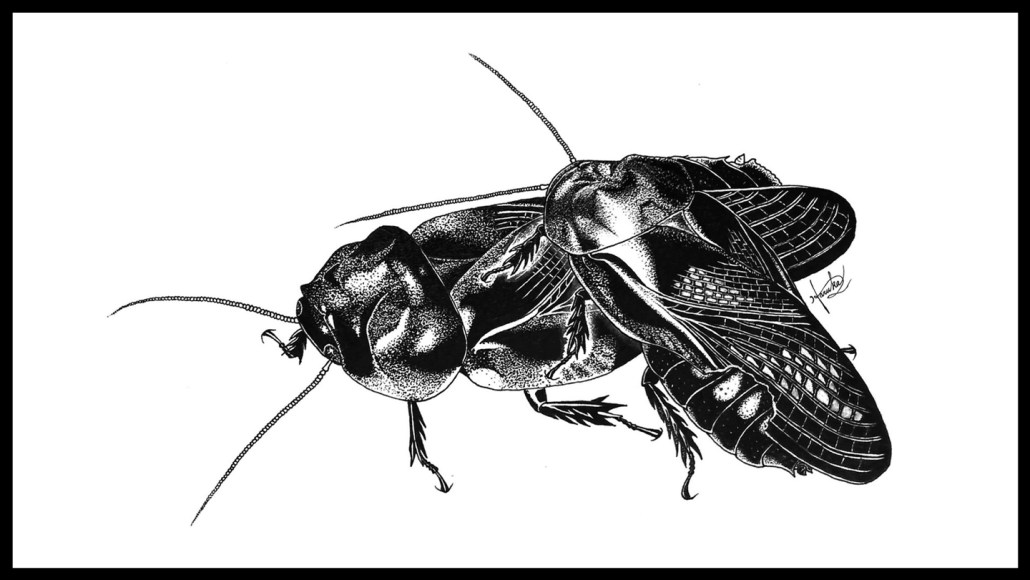
Haruka Osaki, a talented artist as well as scientist, drew these two roaches in the process of “gently” eating each other’s wings off, a task that can occur at any point during the mating and pairing process.
Haruka Osaki, H. Osaki and E. Kasuya/Ethology 2021
Humans might show commitment with a ring, penguins offer prospective mates rocks and some beetles gift a ball of dung. Wood-feeding cockroaches show commitment with a nibble of cannibalism — and then a lot of aggression.
After a ritual in which mating roaches gnaw off each other’s wings, the pair violently reject all other potential mates or intruders. The findings, published March 4 in Royal Society Open Science, offer evidence that pair-bonding is not limited to creatures with spines. Insects can show fierce loyalty, too.
The wood-feeding cockroach Salganea taiwanensis can live for up to five years, and forms long-term monogamous pairs, says Haruka Osaki, a behavioral ecologist at the Museum of Nature and Human Activities in Hyōgo, Japan. Once committed, the roaches will build a nest and raise offspring together, cohabitating for the rest of their lives.
But to signal that commitment, a sacrifice is required. The cockroaches can fly — until they decide to settle down. To pair up, a male and female will gently eat each other’s wings off before, during or after mating.
It could be practical, as the nests the animals build are in rotten wood where wings could get trapped, says Lars Chittka, a behavioral ecologist at Queen Mary University of London who was not involved in the study. Or the chemicals released as the animals eat could help them learn the signature of their partner. Either way, it’s a very binding prenup. “It’s a built‑in ‘stay‑and‑invest’ signal for both parties, exactly the sort of irreversible step that often stabilizes cooperation in pair‑living species,” he says.
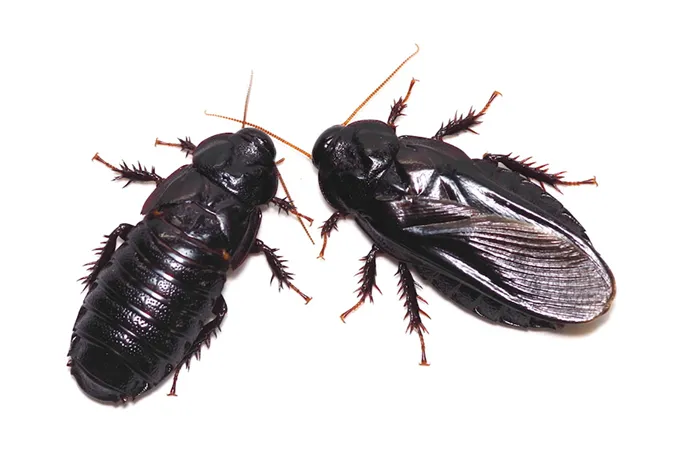
Osaki wanted to understand how this wingless state might affect the pair’s behavior. She and her colleagues tested pairs of roaches, some that had eaten their partner’s wings and some that had not. Each pair was given a nest and then introduced to intruders.
In eight pairs that had not dined on each other, only one male attacked an invading male. But after wing eating, it was two against the world. Paired males and females tolerated only each other and rammed any strangers like tiny insectoid bulls. The roaches even attacked other insects of the opposite sex that might previously have been considered potential mates. If only one partner attacked, the other would wag their abdomens or dig in the nest nearby in support.
The wingless animals might behave differently if their mate is out of the way, though that remains to be tested. But the behavior is “arguably the crispest demonstration of a ‘bond like’” pairing in an insect so far, Chittka says. The roaches go beyond simply parenting together to actively sticking together.
People might assume that insect societies are simplistic, “but studies like ours show that they can form stable and selective partnerships,” Osaki says. Even a roach, it turns out, can commit.