Gene Therapy for Sickle-Cell Disease?
By installing a designer gene that offsets the adverse effects of faulty DNA, scientists have prevented sickle-cell disease in mice. Although this potential gene therapy needs much refinement before it can be tested in people, the early success suggests it could lead to a treatment, say the researchers.
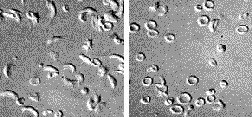
Sickle-cell disease is an inherited disorder of red blood cells. It’s caused by a mutation in the gene that encodes beta globin. This protein is a component of hemoglobin, the oxygen-carrying workhorse in red blood cells.
Deformed beta globin begets faulty hemoglobin, which becomes sticky and forms chains inside red blood cells through a process called polymerization. The chains become rigid and bend the cells into an unnatural, sickle shape.
Earlier studies showed that another protein, gamma globin, inhibits polymerization. By adding part of the gamma globin gene to a beta globin gene, it’s possible to make hemoglobin that resists polymerization. Philippe Leboulch, a gene therapist at Harvard Medical School in Boston and the Massachusetts Institute of Technology, and his colleagues have devised a gene therapy using this modified gene.
Red blood cells arise from stem cells in bone marrow. Leboulch and his team took bone marrow from mice with sickle-cell disease and added the modified gene to it. To see whether this prevented blood cells from sickling, they injected the marrow into healthy mice whose own marrow had been irradiated and wiped out. These mice didn’t develop sickle-cell disease, while mice injected with marrow not given the new gene became ill, the team reports in the Dec. 14 Science.
The scientists introduced the modified beta globin gene into marrow cells by packaging it with a small piece of genetic material normally found in the human immunodeficiency virus (HIV). The researchers also added DNA that naturally assists in production of beta globin, Leboulch says. The resulting combination infiltrates stem cells in the marrow and delivers its genetic cargo.
After 10 months, nearly all the red blood cells in the mice getting gene therapy were making beta globin encoded by the engineered gene, the researchers report. As a result, the animals’ hemoglobin was resistant to polymerization, and few sickle cells arose from their marrow stem cells, Leboulch says.
Although using a piece of HIV as a vehicle for delivering therapeutic genes to people carries with it “technical and perception problems,” it remains an option worth pursuing, says molecular biologist Theodore Friedmann of the University of California, San Diego School of Medicine. “This is a very impressive piece of work,” he says.
Red blood cells are normally malleable and disk-shaped, which enables them to flow freely through small vessels. In contrast, sickled cells are rigid and jagged. They impede blood flow by sticking to each other and to other cells. When this clumping blocks blood flow, it can damage organs.
Also, sickled cells cause anemia because the immune system destroys them–after they’re damaged by polymerization–faster than the marrow can replace them. This anemia leaves the body oxygen starved and causes the pain and fatigue of sickle-cell disease, says molecular geneticist Thomas M. Ryan of the University of Alabama–Birmingham.
The new study demonstrates a good gene-delivery system, says Ryan. But he adds that questions linger about the wisdom of therapies that include total marrow destruction, a treatment that can be lethal.
Leboulch acknowledges that such therapy is harsh. In future experiments, probably in monkeys, he intends to try partial destruction of the bone marrow. Although some stem cells would still yield deformed red blood cells, a transplant of new stem cells carrying therapeutic genes might make enough good red blood cells to quell the disease, he says.