Living Long in the Tooth: Grandparents may have rocked late Stone Age
A memorable senior moment may have occurred toward the end of the Stone Age. Around 30,000 years ago, the number of people surviving long enough to become grandparents dramatically increased, altering the social landscape and provoking major cultural innovations, according to two anthropologists.
Their analysis of fossil teeth from human ancestors indicates that Homo sapiens from the late Stone Age—but not Neandertals or other members of our evolutionary family—exhibited a sharp rise in the population of individuals older than 30 years. Data from hunter-gatherer groups today suggest that among prehistoric H. sapiens, women first bore children at about age 15 and would have become grandmothers at around age 30, say Rachel Caspari of the University of Michigan in Ann Arbor and Sang-Hee Lee of the University of California, Riverside.
Caspari and Lee theorize that prehistoric grandparents sparked growth among Stone Age populations by caring for grandkids. The resulting larger populations developed complex social systems, the researchers suspect, which fostered the explosion of artwork and ornamentation, such as that discovered previously by archaeologists.
“Increased longevity came late in human evolution and may explain the big time lag between the origins of modern human biology [at least 200,000 years ago] and modern human behavior,” Caspari says.
The new report appears in an upcoming Proceedings of the National Academy of Sciences.
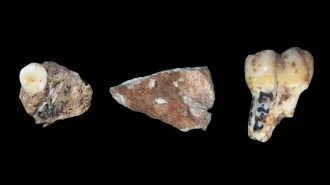
Caspari and Lee studied the fossil teeth of 768 adults from four groups in the human evolutionary family: australopithecines that lived from 3 million to 1.5 million years ago, early Homo species dating to between 1.5 million and 250,000 years ago, Neandertals from 130,000 to 30,000 years ago, and H. sapiens that lived from 30,000 to 18,000 years ago.
For each group, the researchers measured wear on fossil samples of children’s molars and then estimated the rate at which further wear would occur through adulthood. Armed with that information, they divided each group of adults’ teeth into those from individuals age 15 to 30 and age 30 or more.
Young adults greatly outnumbered older adults in australopithecines, early Homo, and Neandertals. A turnaround occurred in late–Stone Age H. sapiens; the investigators tallied about two old adults for every young adult.
A team led by anthropologist Kristen Hawkes of the University of Utah in Salt Lake City previously theorized that as far back as 2 million years ago, females began to routinely live long enough to reach menopause.
Hawkes says that she’s “flabbergasted” at Caspari and Lee’s results. It’s hard to know whether the fossil teeth in their study represent actual proportions of old and young adults in the four groups, Hawkes cautions.
Caspari and Lee’s results are “probably valid,” remarks anatomist Jay Kelley of the University of Illinois in Chicago. Other analyses of brain size and tooth development in human ancestors indicate that, contrary to Hawkes’ view, extended life spans emerged no earlier than roughly 400,000 years ago, Kelley says.