In this new infrared portrait of a nearby star-forming region, fierce winds and harsh ultraviolet light from massive stars have shredded a dusty cocoon, exposing baby stars, each at the tip of one of the cocoon’s remnants. Arrow points to one such star.
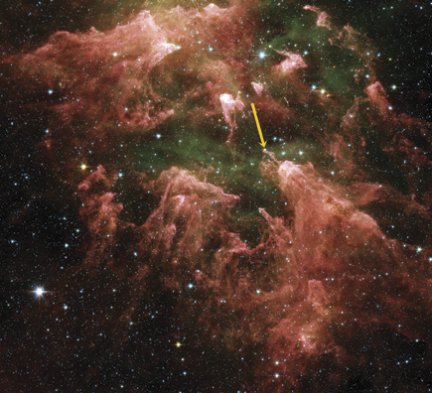
The infrared sensitivity of NASA’s Spitzer Space Telescope enabled it to peer through the dust, which lies in the Carina nebula 10,000 light-years from Earth. The most massive stars in the nebula lie above the frame of the image. By disrupting the stellar nursery, these massive bullies prevent the newborns from packing on more material. NASA released the false-color image last week at a meeting of the American Astronomical Society in Minneapolis.