Humans
We summarize the week's scientific breakthroughs every Thursday.
- Health & Medicine
Malaysia is ground zero for the next malaria menace
With deforestation in Malaysia, monkeys and humans are getting closer — and mosquitoes are infecting humans with malaria from monkeys.
- Materials Science
Questions about toxic red tides, and more reader feedback
Readers had inquiries about a new deicing material, harmful algal blooms and more.
- Anthropology
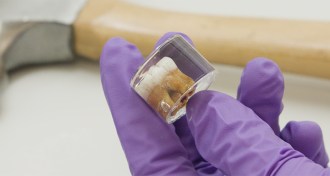
Neandertal teeth reveal the earliest known signs of lead exposure
Chemical analyses of teeth from young Neandertals show that lead exposure in hominids goes back some 250,000 years.
- Archaeology
Fossils hint hominids migrated through a ‘green’ Arabia 300,000 years ago
A once-green Arabia may have enabled Stone Age entries by Homo groups.
- Tech
Virtual reality therapy has real-life benefits for some mental disorders
Cheap, user-friendly virtual reality hardware could help VR therapy go mainstream. Some treatments are ready for primetime, while others are still in early testing.
- Health & Medicine
The appendix is implicated in Parkinson’s disease
Removal of the appendix reduced the risk of developing Parkinson’s disease, an analysis of nearly 1.7 million health records in Sweden suggests.
- Archaeology
People in the Pacific Northwest smoked tobacco long before Europeans showed up
Ancient indigenous groups in the Pacific Northwest used tobacco roughly 600 years before European settlers ventured west with the plant.
- Archaeology
Ancient South Americans tasted chocolate 1,500 years before anyone else
Artifacts with traces of cacao push back the known date for when the plant was first domesticated by 1,500 years.
- Health & Medicine
What the approval of the new flu drug Xofluza means for you
Xofluza, the first flu antiviral to be approved in 20 years, works differently from other flu drugs.
- Archaeology
Ancient Clovis people may have taken tool cues from earlier Americans
Ancient Americans’ spearpoints may have heralded later Clovis weapons.
- Life
Why some people may be more susceptible to deadly C. difficile infections
Proline, a type of amino acid, increases when gut microbe mixes are disturbed, giving this pathogen a ready food source.
- Health & Medicine
Teens use Juul e-cigarettes much more often than other vaping products
Such devices are more popular among youth than other e-cigarettes or regular cigarettes, a study finds.