All Stories
- Science & Society
Finalists chosen to compete in the 2015 Intel Science Talent Search
Teens from 18 states will soon face off in the finals of the 2015 Intel Science Talent Search, the nation’s most prestigious science research competition for high school seniors.
- Plants
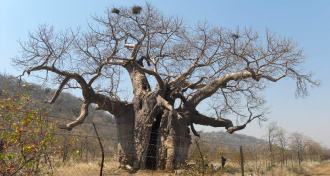
Huge, hollow baobab trees are actually multiple fused stems
The trunk of an African baobab tree can grow to be many meters in diameter but hollow inside. The shape, researchers say, occurs when several stems fuse together.
- Animals
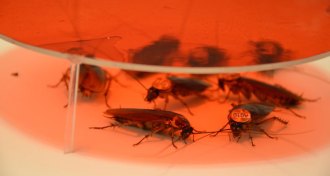
Cockroach personalities can speed or slow group decisions
The mix of temperaments in an alarmed cluster of cockroaches changes how quickly they make group decisions.
- Humans
Baby brains undergo dramatic changes in utero
Developing human brains experience more than 28,000 changes in a molecular process that governs gene activity.
- Plants
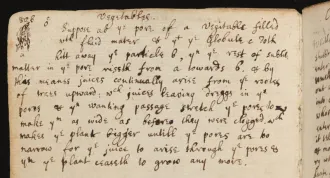
Isaac Newton’s theory of how water defies gravity in plants
A passage in one of Isaac Newton’s journals reveals that he may have theorized basic plant hydrodynamics long before botanists.
- Animals
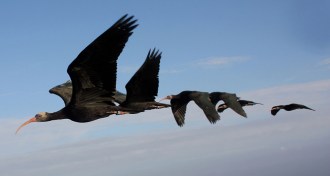
Migrating ibises take turns leading the flying V
During migration, ibises flying in a V formation cooperate and take turns flying in wake to save energy, a new study suggests.
- Particle Physics
New particle may be made of four quarks
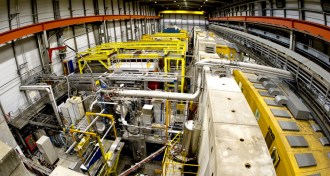
A newly discovered particle may be comprised of four quarks, a new study posits.
- Environment
Tuna mercury rising
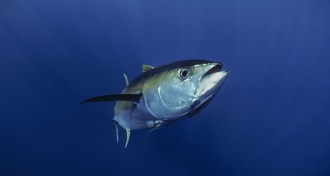
From 1998 to 2008, mercury levels in Hawaiian Yellowfin tuna have increased by 3.8 percent per year, researchers suggest.
- Climate
Warming Arctic will let Atlantic and Pacific fish mix
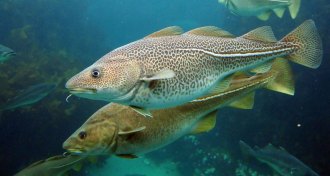
The ultra-cold, ice-covered Arctic Ocean has kept fish species from the Atlantic and Pacific separate for more than a million years — but global warming is changing that.
- Anthropology
Ancient Maya bookmakers get paged in Guatemala
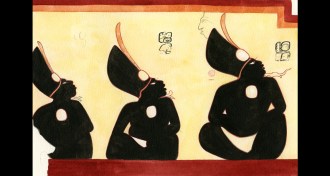
New discoveries peg ritual specialists as force behind bark-paper tomes and wall murals.
- Physics
When entering a black hole, fasten your seat belt
Rapidly spinning black holes can generate turbulence, a new analysis shows.
- Astronomy
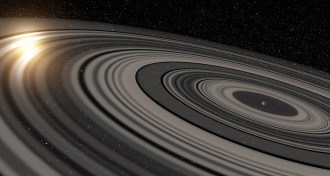
Giant rings encircle young exoplanet
Stretching 90 million kilometers from their center, 37 stripes of dust around exoplanet were probably crafted by moons.