Human genes often best Neandertal ones in brain, testes
Researchers measured activity in people who have one version of each gene
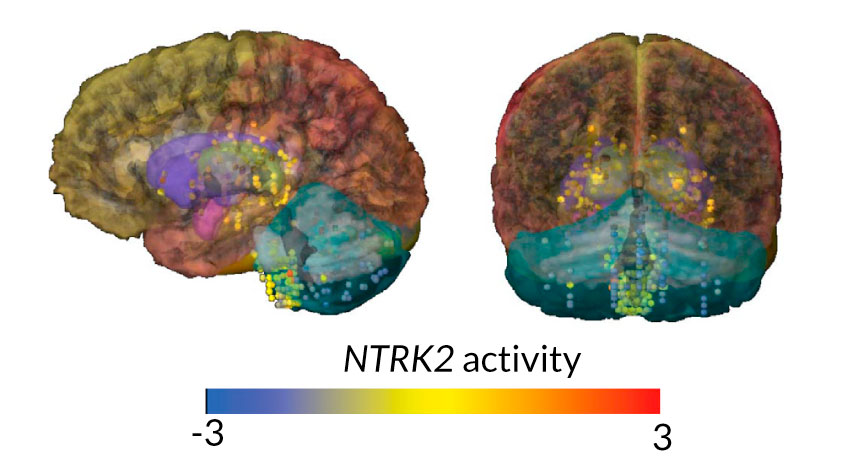
BRAIN ACTIVITY Human versions of some genes are more active in certain parts of the brain than Neandertal versions. Side and back views of a brain show that activity levels of the Neandertal version of a gene called NTRK2 are lower in the cerebellum (blue area in lower back) than in other regions.
R.C. McCoy, J. Wakefield and J.M. Akey/Cell 2017

Humans and Neandertals are still in an evolutionary contest, a new study suggests.
Geneticist Joshua Akey of the University of Washington in Seattle and colleagues examined gene activity of more than 700 genes in which at least one person carried a human and a Neandertal version of the gene. Human versions of some genes are more active than Neandertal versions, especially in the brain and testes, the researchers report February 23 in Cell. In other tissues, some Neandertal versions of genes were more active than their human counterparts.
In the brain, human versions were favored over Neandertal variants in the cerebellum and basal ganglia. That finding may help explain why Neandertals had proportionally smaller cerebellums than humans do. Neandertal versions of genes in the testes, including some needed for sperm function, were also less active than human varieties. That finding is consistent