The Smithsonian’s ‘Lights Out’ inspires visitors to save the fading night sky
The exhibition explores the harms of light pollution and how to reduce them
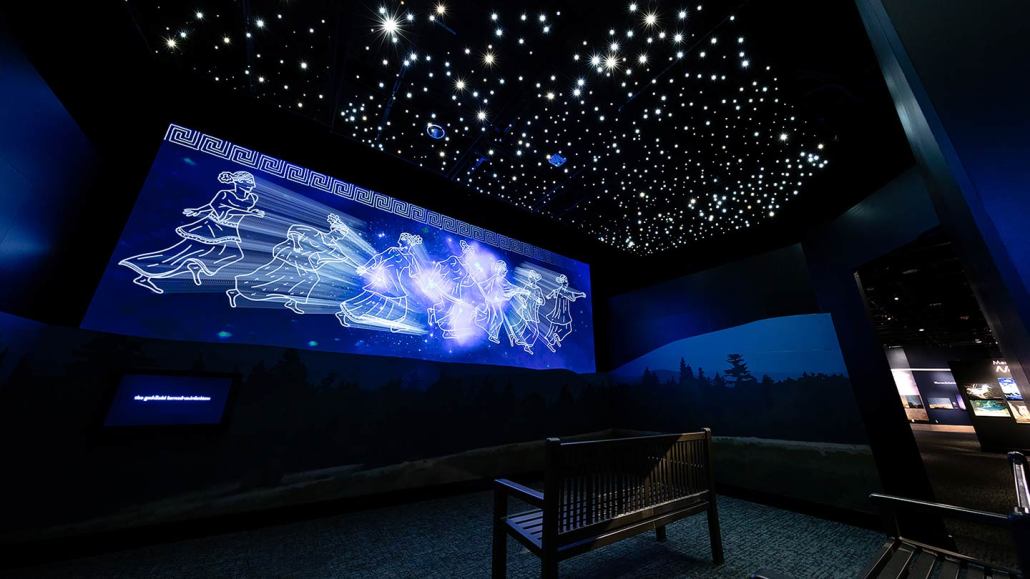
In “Lights Out,” a film shows how different cultures have explained the origin of the star cluster called Messier 45. The ancient Greeks believed the Pleiades, or Seven Sisters, turned into stars to escape the hunter Orion.
Brittany M. Hance, James D. Tiller, Phillip R. Lee and James Di Loreto/Smithsonian Institution
Bright, artificial lights are drowning out the night sky’s natural glow. Now, an exhibition is highlighting some of the consequences of a fading starry night — and how people can help restore it.
“Lights Out,” open through 2025 at the Smithsonian National Museum of Natural History in Washington, D.C., illuminates how light pollution is affecting astronomy, natural ecosystems and human cultures around the world. “We want people to understand that it’s a global problem, and it’s having broad impact,” says Jill Johnson, an exhibit developer at the museum.
Upon entering the exhibition, the dimly lit space resets the mood for nighttime exploration. The exhibition spans a long hallway that can be entered from either end. One entrance quickly draws in visitors with a personal connection. An interactive display invites you to experience your own night sky, whether in a city, suburb or remote location. Three tactile panels feature raised elements, including dots representing light pollution and crosses indicating visible stars. The more populated a place, the more dots are smattered across the panel.
Visitors can also listen to the artificial light and starlight in each sky through data that have been translated into sound. The multisensory experience is especially engaging for visitors who may not be able to experience the exhibition visually.
The other entrance offers a more didactic introduction to the exhibition. A timeline presents a brief history of human-made light, from fire-lit torches to today’s LEDs, and then segues to astronomy (SN: 1/19/23). Space scientists rely on light, both visible and not, to understand celestial bodies. And their views of the universe have become increasingly obstructed by artificial light.
“Astronomers were some of the first folks to sound the alarm on light pollution,” says Ryan Lavery, a public affairs specialist at the museum.
Astronomers aren’t the only scientists who have noticed the repercussions. Biologists have observed light pollution’s toll on plants and animals, whether harming corals’ moonlight-triggered reproduction or bats’ ability to pollinate flowers. Here, much of the evidence on display is visual. Photographs and specimens demonstrate the variety of critters that are active at night, while a glass case of preserved birds presents the grim consequences of light pollution. All of these birds died from striking buildings in Washington, D.C., or Baltimore after being disoriented by the bright cityscapes.
Losing dark, starry nights also affects human cultures. Another area of the exhibition presents people’s ancient and modern-day connections to the night sky through photographs, stories and cultural items. A glistening beadwork depicting the Milky Way was crafted specially for “Lights Out” by Gwich’in artist Margaret Nazon, who grew up staring at the stars in Canada’s Northwest Territories.
Our connections under a shared sky are emphasized in the exhibition’s small central theater. It replicates a starry night over Coudersport, Pa., through speckled lighting and walls bearing illustrations of trees and hills. A short film describes the star cluster Messier 45, also known as the Pleiades, and explains the stars’ origins according to tales from three cultures — the ancient Greeks, the Ainu in Japan and the Māori in New Zealand.
“Lights Out”
Through December 2025
Smithsonian National Museum of Natural History | Washington, D.C.
“Cultures all over the world have a deep relationship to the night sky,” says Stephen Loring, cocurator of the exhibition and an archaeologist at the museum. “If we lose the night sky, we lose an avenue to our understanding of what it is to be a human being.”
But the exhibition isn’t all bleak. Sprinkled throughout it are success stories of how people are reducing light pollution, from France’s outdoor lighting curfews to beach communities that have altered their lighting systems to avoid drawing hatchling sea turtles away from the ocean. And visitors may be heartened to learn about simple but meaningful actions that they can take, such as aiming outdoor lights downward and using the dimmest settings.
Overall, “Lights Out” instills a sense of hope and a desire to reconnect with the night sky. “This is an optimistic exhibition,” Loring says. “We can solve this problem.”