For decades, astronomers have faced an embarrassing problem. They can’t find most of the mass in our own galaxy, let alone the universe.
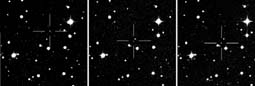
Simply put, the tug exerted by all the visible matter in the Milky Way isn’t enough to keep all the galaxy’s stars and gas from flying apart. There has to be much more matter than meets the eye. Too dark to be seen, this proposed mystery material would envelop the visible galaxy and provide the extra tug.
A new study adds to the evidence that astronomers have unveiled some of the dark matter in our galaxy, and that it’s pretty ordinary stuff: white dwarfs, the cold, compact embers of low-mass stars. Scanning digitized images of about 10 percent of the southern sky, a team led by Ben R. Oppenheimer of the University of California, Berkeley found 38 previously unseen white dwarfs within 450 light-years of Earth.
The velocities of the newly discovered white dwarfs suggest that they reside in the so-called halo, a spherical distribution of stars and gas that surrounds our disk-shaped, spiral galaxy. Extrapolating from the new finds, the team calculates that white dwarfs account for at least 3 percent of the Milky Way’s dark matter and perhaps as much as 35 percent.
Oppenheimer and his collaborators describe their results in Sciencexpress, the online supplement to the March 23 Science. Two years ago, another team reported the discovery of about 20 extremely faint white dwarfs, also residents of the Milky Way, in a much smaller patch of sky (SN: 9/18/99, p. 180).
Taken together, the findings suggest that white dwarfs could be some of the elusive MACHOs (massive compact halo objects) that scientists have deduced must reside at the outskirts of the galaxy (SN: 4/29/95, p. 261).
Oppenheimer emphasizes that the results don’t shed light on the bulk of dark matter throughout the universe. The Big Bang theory predicts that 95 percent of dark matter is of some exotic type not made from protons and neutrons. Although the amount of ordinary dark matter, such as white dwarfs, may be higher in our own galaxy, exotic dark matter dominates the cosmos at large. Astronomers have yet to identify it.
The abundance of white dwarfs, fossils of stars born in our galaxy’s earliest days, may force astronomers to revise their views about early star formation in this galaxy and perhaps others, says Oppenheimer. He notes that the observed white dwarfs represent the end stage of stars roughly the mass of the sun. Lower-mass stars evolve so slowly that they haven’t had time to form white dwarfs since the beginning of the cosmos.
Studies suggest, however, that the number of low-mass stars in the Milky Way is only one-twentieth of the population of white dwarfs. That indicates that when the halo of our galaxy formed, it contained far fewer low-mass stars than heavier, sunlike
stars–just the opposite of what is seen in star-forming regions today.
The findings “are indeed fascinating” and pose several conundrums if white dwarfs really do make up a significant amount of our galaxy’s halo, says Rosemary F.G. Wyse of Johns Hopkins University in Baltimore. That won’t be proved, she says, until follow-up studies are completed.