3,982 results
3,982 results for:
- Animals
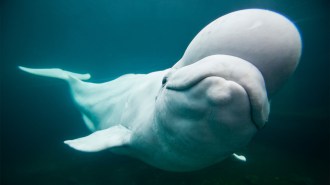
Belugas may communicate by warping a blob of forehead fat
Jiggling the “melon” like Jell-O seems to be associated with sexual behaviors, scientists say.
- Artificial Intelligence
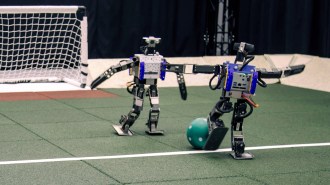
Reinforcement learning AI might bring humanoid robots to the real world
Reinforcement learning techniques could be the keys to integrating robots — who use machine learning to output more than words — into the real world.
- Health & Medicine
What can period blood reveal about a person’s health?
The FDA recently approved a menstrual blood test for diabetes, the first diagnostic of any kind based on period blood. It may be just the beginning.
- Artificial Intelligence
Why large language models aren’t headed toward humanlike understanding
Unlike people, today's generative AI isn’t good at learning concepts that it can apply to new situations.
- Climate
Numbats are built to hold heat, making climate change extra risky for the marsupials
New thermal imaging shows how fast numbats’ surface temperature rises even at relatively reasonable temperatures.
- Math
How two outsiders tackled the mystery of arithmetic progressions
Computer scientists made progress on a decades-old puzzle in a subfield of mathematics known as combinatorics.
- Artificial Intelligence
AI chatbots can be tricked into misbehaving. Can scientists stop it?
To develop better safeguards, computer scientists are studying how people have manipulated generative AI chatbots into answering harmful questions.
-
Antimatter falls like matter, upholding Einstein’s theory of gravity
In a first, scientists dropped antihydrogen atoms and measured how they fell.
- Animals
Fake fog, ‘re-skinning’ and ‘sea-weeding’ could help coral reefs survive
Coral reefs are in global peril, but scientists around the world are working hard to find ways to help them survive the Anthropocene.
- Quantum Physics
Quantum computers could break the internet. Here’s how to save it
Today's encryption schemes will be vulnerable to future quantum computers, but new algorithms and a quantum internet could help.
-
New discoveries are bringing the world of pterosaurs to life
The latest clues hint at where pterosaurs — the first vertebrates to fly — came from, how they evolved, what they ate and more.
- Animals
This sea cucumber shoots sticky tubes out of its butt. Its genes hint at how
A new genetics study is providing a wealth of information about silky, sticky tubes, called the Cuvierian organ, that sea cucumbers use to tangle foes.