Space
We summarize the week's scientific breakthroughs every Thursday.
- Ecosystems
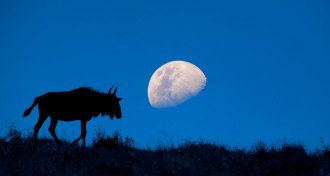
Moonlight shapes how some animals move, grow and even sing
The moon’s light influences lion prey behavior, dung beetle navigation, fish growth, mass migrations and birdsong.
- Planetary Science
Readers wanted to know about asteroids, lithium batteries and more
Readers had questions and comments about asteroids, lithium batteries, and pyroclastic flows.
- Astronomy
After all this time, the moon still manages to surprise us
Editor in Chief Nancy Shute discusses 50 years of lunar science.
- Astronomy
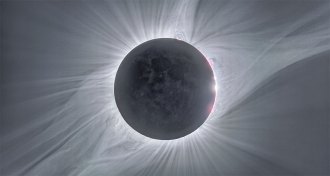
How the 2019 eclipse will differ from 2017’s — and what that means for science
This year’s total solar eclipse is visible late in the day from a relatively small slice of South America.
- Astronomy
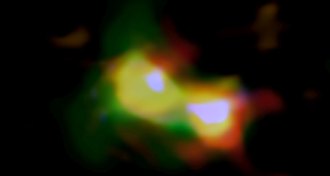
The earliest known galaxy merger occurred shortly after the Big Bang
Telescopes show two distant blobs of stars and gas swirling around each other in the young universe.
- Planetary Science
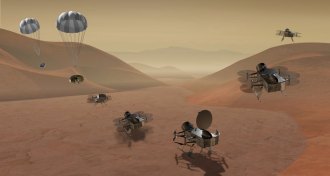
With Dragonfly, NASA is heading back to Saturn’s moon Titan
NASA’s next robotic mission to explore the solar system is headed to Saturn’s largest moon, Titan.
- Astronomy
In a first, telescopes tracked a lone fast radio burst to a faraway galaxy
First-time observations suggest that the cause of one-time fast radio bursts is different from what triggers repeatedly flashing radio bursts.
- Astronomy
A new algorithm finds nearby stars that could host hidden worlds
An algorithm dubbed “Netflix for exoplanets” identified more than 350 stars that, based on their chemistry, might have planets orbiting out of sight.
- Astronomy
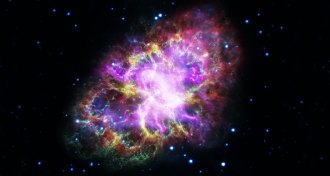
The highest-energy photons ever seen hail from the Crab Nebula
An experiment in Tibet spotted photons with over 100 trillion electron volts of energy.
- Astronomy
The cosmic ‘Cow’ may be a strange supernova
New observations suggest the strange bright burst called the ‘Cow’ was a supernova, rather than a shredded star.
- Tech
How NASA’s portable atomic clock could revolutionize space travel
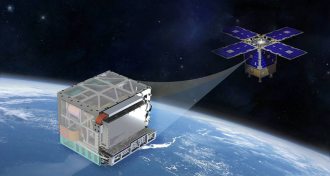
An atomic clock designed to enable self-driving spaceships and GPS-like navigation on other planets is about to take a yearlong test flight.
- Astronomy
Readers boggled by black hole behemoth
Readers had questions about the first image of a black hole and a chytrid fungus.