Tech
We summarize the week's scientific breakthroughs every Thursday.
- Materials Science
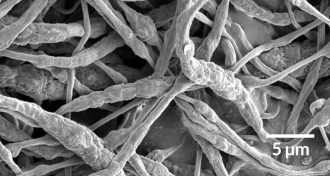
New ‘smart’ fibers curb fires in lithium-ion batteries
To stifle battery fires, scientists create component with heat-release flame retardant.
- Earth
Mapping the future of continents and batteries
Editor in chief Eva Emerson discusses how science provides new perspectives on the past and the future.
- Computing
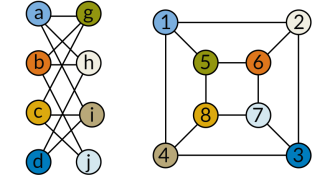
Retracted result on network equivalence reinstated
Graph isomorphism result still stands, despite error.
- Math
Hidden Figures highlights three black women who were vital to the U.S. space program
"Hidden Figures" tells the untold story of the "human computers" who were essential to the launch of the U.S. space program.
- Tech
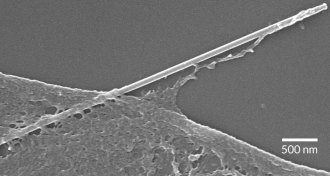
Cells snack on nanowires
Human cells eat silicon nanowires in a process called phagocytosis. Nanowire-infused cells could be a step towards biological electronic devices.
- Computing
Year in review: AlphaGo scores a win for artificial intelligence
AlphaGo’s triumph over its human opponent provides a glimpse into the future of artificial intelligence.
- Tech
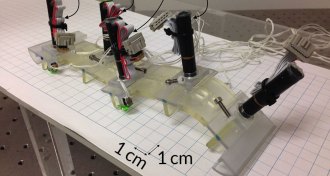
Caterpillar robot uses squishy, 3-D printed legs to inch and crawl
Squishy, 3-D printed legs help a caterpillar robot switch between inching and crawling, and offer sensory info about the world.
- Tech
Rise of reusable rockets signals a new age of spaceflight
Successful landings by SpaceX and Blue Origin raise the prospect of cheaper and more efficient spaceflight.
- Tech
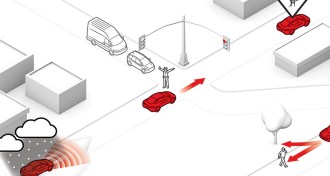
Five challenges for self-driving cars
Scientific and technical experts weigh in on the biggest hurdles for autonomous vehicles, and how ongoing research will help.
- Materials Science
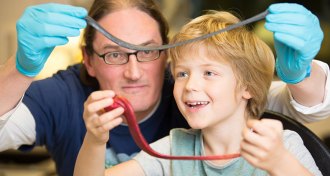
Graphene Silly Putty detects pitter-patter of spider footsteps
Sensor made of graphene and Silly Putty can detect pulse, breathing — and spider feet.
- Tech
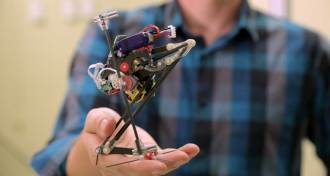
Zippy new jumping bot catches air again and again
Leaping robot can bounce from floor to wall, parkour-style, and, like a bush baby, uses a “super-crouch” to get extra oomph out of jumps.
- Science & Society
Readers respond to the SN 10, and awards for Science News
The human side of science, cool cloth and more in reader feedback.