Grains of silt embedded in thick sediments in China may settle a debate about the age of a nearby desert, scientists say.
The Taklimakan Desert of northwestern China covers nearly 337,000 square kilometers, about 85 percent of which consists of shifting sand dunes that support little or no vegetation. Previous estimates of the desert’s age range from about 1 million to 3.5 million years, says Jimin Sun, a geologist at the Chinese Academy of Sciences in Beijing. The estimates vary widely because scientists hadn’t found sediment layers that could be accurately dated, he notes.
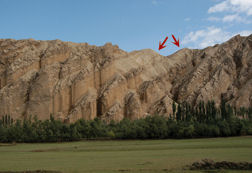
Now, Sun and his colleagues have found that the desert may be older than researchers had previously suspected. Sun’s team analyzed materials in layers of rock formations found at a site on the southern fringe of the desert. The lowest layers of the 1.6-kilometer-thick deposit consist of alternating layers of gravel and reddish silt laid down by an ancient river. However, the silt in the overlying layers is light yellow, and the sizes and surface textures of its grains are similar to those in windblown deposits currently accumulating in the nearby Kunlun Mountains. That material originates in the Taklimakan Desert, says Sun.
Magnetic characteristics of the strata suggest that they were deposited beginning about 6.5 million years ago. The first layers that contain the yellow silt that presumably came from the Taklimakan Desert are about 5.3 million years old, Sun and his colleagues report in the June 16 Science.
Tectonic uplift of northern Tibet at that time could have created the desert by modifying atmospheric circulation in the region, blocking off Arctic storms from the north and the Asian monsoons from the south, the researchers speculate.