
Chemical traces of Cold War-era nuclear tests found in whale shark vertebrae offer a new clue about just how long these massive fish live.
Wayne Osborn
Radioactive residue from Cold War nuclear tests has given scientists a cipher to decode the ages of whale sharks, written on the animals’ vertebrae.
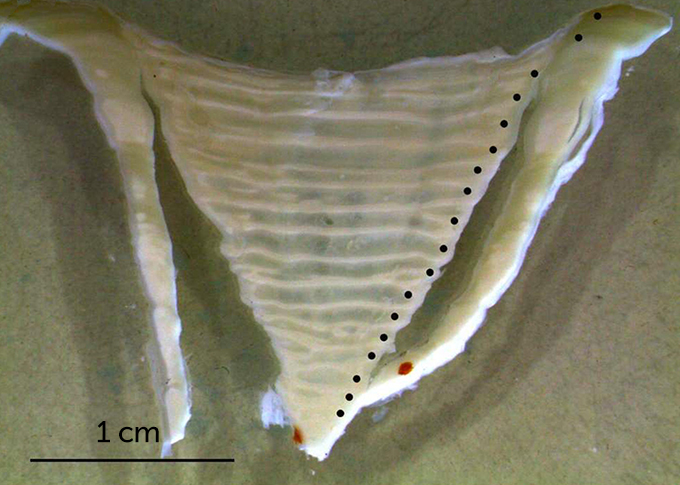
Whale sharks (Rhincodon typus) accumulate alternating stripes of opaque and translucent tissue on their vertebrae as they age, similar to the way tree trunks grow rings. But until now, scientists haven’t known whether whale shark vertebrae gain a new growth band each year or every six months — making it difficult to gauge just how fast these sharks grow or how long they live.
New measurements of carbon-14 in the vertebrae of two whale sharks that lived during the 20th century suggest that growth bands form annually, researchers report in the April 2020 Frontiers in Marine Science. Soviet and American nuclear weapons tests in the 1950s and 1960s produced that carbon-14, which built up in Earth’s atmosphere and oceans. By matching the amount of carbon-14 in different vertebral growth bands with the known carbon-14 levels in surface seawater in different years, the researchers estimated when each band formed — and found that subsequent bands generally grew a year apart.
The total number of growth bands in each dated vertebra indicated that one whale shark, a 10-meter male found in Taiwan, was about 35 years old when it died. The other shark, a female of about the same size collected in Pakistan, was around 50 years old.
“It is really, really likely that there are older whale sharks out there, simply because we know there are much larger whale sharks,” says Steven Campana, a fisheries scientist at the University of Iceland in Reykjavík. Whale sharks are known to grow up to about 18 meters long.
Campana and colleagues used vertebral growth-band counts to figure out the ages of 18 additional dead whale sharks, which ranged from 15 to 25 years old. Those sharks measured 2.7 to almost 6 meters in length. Based on the lengths of sharks of different ages, the researchers estimated that young whale sharks grow about 20 centimeters per year, on average.
Information on the life spans and growth rates of whale sharks could inform conservation strategies to protect this endangered species, Campana says. “Long-lived animals like whale sharks almost certainly become mature at a relatively old age, and their populations are relatively slow to increase their numbers.” So whale shark populations may not bounce back from threats like overfishing as quickly as species with shorter life cycles.
Fisheries biologist Allen Andrews cautions that there is some uncertainty in the carbon-14 dating technique that Campana’s team used, because radioactive carbon from nuclear tests did not spread evenly throughout Earth’s oceans. What’s more, “young [whale] sharks disappear for a big portion of their lives,” says Andrews, of the University of Hawaii at Manoa. If young whale sharks spend much of their time deep underwater, they may not receive the same dose of carbon-14 as measured at the ocean’s surface.
Researchers could further investigate whale shark growth by tagging live sharks and then recapturing them, measuring how much the animals grew in the interim, Andrews says.