Uncategorized
-
LifeFlightless birds’ history upset by ancient DNA
The closest known relatives of New Zealand’s small, flightless kiwis were Madagascar’s elephant birds, so ancestors must have done some flying rather than just drifting with continents.
By Susan Milius -
Health & MedicineParasite protein offers new hope for malaria vaccine
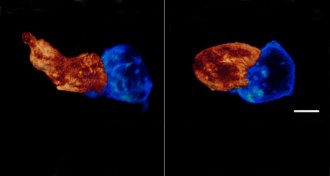
A newly discovered malarial protein triggers the immune system to trap disease-causing parasites in red blood cells. The protein offers scientists a promising target for vaccines.
By Meghan Rosen -
NeuroscienceLife span lengthens when mice feel less pain
When rodents are missing a sensory protein, their metabolism revs up and they live longer.
-
CosmologyDustup emerges over gravitational waves discovery
While cosmologists wait for data from Planck satellite, some worry that BICEP2 data actually come from our galaxy.
-
LifeIn a surprise find, placentas harbor bacteria
Mouth bacteria make their way to the placenta. Some mixes may trigger premature birth.
-
Quantum PhysicsQuantum cryptography could shed test for hackers
An added protection of a proposed quantum cryptography method makes eavesdropping nearly impossible.
By Andrew Grant -
LifeGenes gives clues to outcome of species interbreeding
Genetics provides clues to why hybrid river fish formed a subspecies but insects formed a new species.
-
ClimateEnvironmental change may spur growth of ‘rock snot’
A controversial new theory suggests alga that forms rock snot isn’t an invader, but a low-key species native to many rivers.
By Beth Mole -
ClimateForest fires may speed demise of Greenland’s ice sheet
Black carbon released by burning woodland darkens Greenland’s ice sheet, quickening its melt.
By Beth Mole -
AnimalsLizards may scale back head bobbing to avoid predators
Brown anoles may scale back mating signals to avoid being eaten.
By Meghan Rosen -
Physics‘The Sound Book’ explores echoes, bad acoustics and more
Acoustic engineer Trevor Cox provides an international tour of aural amazements.
By Sid Perkins -
Particle PhysicsProposed experiment would create matter from light
Photon collider would convert light into electrons and positrons.
By Andrew Grant