Crystal Clear: Liquid crystal sensor plays nature’s game
Thanks to billions of years of evolution, cells are remarkably adept at detecting pathogens or toxic chemicals in the environment. Taking advantage of this natural surveillance capability, researchers have incorporated components of cell membranes into sensors to sniff out dangerous chemical and biological agents.

Led by chemical engineer Nicholas L. Abbott at the University of Wisconsin–Madison, the researchers placed a layer of phospholipids–the fatty acids constituting cell membranes–on top of a liquid crystal. “These are the same liquid crystals you find in laptop-computer displays,” says Abbott.
In the new sensing scheme, the lipids attach themselves to the rod-shaped liquid crystal molecules, which lie perpendicular to the surface and appear dark. When the researchers expose the sensor to an aqueous stream containing a protein that binds to lipids, the liquid crystal molecules respond within seconds by switching to a planar orientation. Viewed under a microscope, the crystals then transmit polarized light and appear bright.
“This is a beautiful example of how one can use novel materials to create a signal,” says Chad Mirkin, a chemist at Northwestern University in Evanston, Ill.
By adding different receptors to the lipids, researchers can tune the sensor to detect specific molecules. For instance, when Abbott and his colleagues attached a receptor called biotin to the lipids, the sensor detected a bacterial protein that binds to biotin. The researchers describe their results in the Dec. 19 Science.
Abbott’s team has made sensors out of liquid crystals before (SN: 8/18/01, p. 103: Available to subscribers at Accelerators load some new ammo: Crystals), but those sensors didn’t include membrane components. When attached to fluid lipid molecules, receptors can move about freely instead of being fixed in one place.
“That becomes important for binding things like viruses,” which attach to several receptors at once on cell surfaces, says Abbott. Mobile receptors in the artificial sensors can reorganize to bind specific targets just as receptors in a cell do.
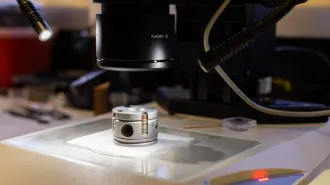
Because the sensors don’t require electric power, Abbott envisions deploying networks of coin-size devices for long-term monitoring in the field. Researchers could shine a laser on the sensors to determine the orientation of the liquid crystals. Says Abbott: “You could interrogate the sensors from 1,000 feet away on the ground or from a helicopter.”
Although the sensitivity of the new sensor is not yet as high as that of others in development, the device is part of a new generation of inexpensive, sophisticated sensors, says Mirkin. Existing sensors are not sufficient in this new era of homeland security, he adds.
The Wisconsin group is currently increasing the sensitivity of its device and focusing on detecting dangerous molecules, such as cholera toxins and chemical and biowarfare agents.
****************
If you have a comment on this article that you would like considered for publication in Science News, send it to editors@sciencenews.org. Please include your name and location.