Novel nanotubes are now made-to-order
By designing self-assembling parts, researchers have discovered how to make nanotubes with specific sizes and traits.
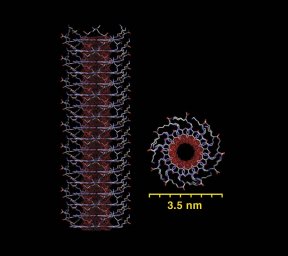
Hicham Fenniri and his team at Purdue University in West Lafayette, Ind., constructed unique molecules as building blocks for nanotubes. Each 1-nanometer molecule contains carbon, nitrogen, oxygen, and hydrogen atoms arranged to resemble the DNA base guanine on one edge of the molecule and cytosine on the other. In DNA, these two bases naturally couple.
In water, the cytosine-like part of one molecule pairs with the guaninelike part of another, says Fenniri. Without any prodding from the researchers, the molecules formed six-molecule rings, with each cytosine edge bonded to a guanine edge. Parts of the resulting ring were attracted to water, and other parts repelled it. So, the rings stacked themselves, putting the water-avoiding, or hydrophobic, portions inside the tubes.
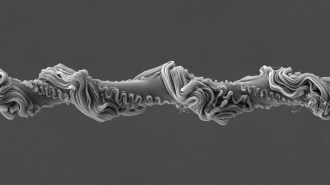
The result, reported in the April 25 Journal of the American Chemical Society, was 3.5-nanometer-wide tubes with rosette cross-sections. Since the starting molecules bond only with identical molecules that fit into the rings, the nanotubes have uniform widths and few defects, says Fenniri.
If researchers design special features into the starting molecules, the new technique could give tubes desired electronic, chemical, or light-emitting properties, says Fenniri. His team has already made 25 double-edged molecules and is now working to assemble them into nanotubes. Such selection offers “almost a salad bar” for designing new tubes, he says.