2,703 results
2,703 results for: Monkeys
- Life
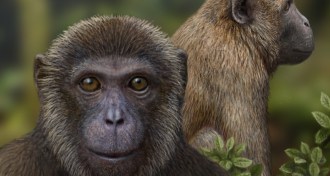
Fossils point to ancient ape-monkey split
Apes and monkeys split from a common ancestor more than 25 million years ago, fossil finds suggest.
- Life
Gone fishing, orangutan-style
Apes that catch fish in ponds and eat them raise the possibility that ancient hominids did the same.
- Chemistry
Spray of zinc marks fertilization
Embryonic development begins with an outpouring of the metal, illustrating chemistry's importance in orchestrating biological processes.
- Health & Medicine
Defending against a Deadly Foe: Vaccine forestalls fearsome virus
A single injection of an experimental vaccine prevents infection by the lethal Marburg virus in monkeys.
- Animals
Monkey Business: Specimen of new species shakes up family tree
The new monkey species found in Tanzania last year may be unusual enough to need a new genus, the first one created for monkeys in nearly 80 years.
- Anthropology
Hybrid-Driven Evolution: Genomes show complexity of human-chimp split
A controversial new genetic comparison suggests that human and chimpanzee ancestors interbred for several million years before evolving into reproductively separate species no more than 6.3 million years ago.
- Health & Medicine
At iconic Asian temple, monkeys harbor viruses
Temple sites in South and Southeast Asia that offer refuge to monkeys also shelter monkey viruses.
- Anthropology
Evolution’s DNA Difference: Noncoding gene tied to origin of human brain
Investigators have discovered a gene that shows signs of having evolved rapidly in people and of having made a substantial contribution to the emergence of a uniquely human brain.
-
Copycat Monkeys: Macaque babies ape adults’ facial feats
Scientists for the first time have established that baby monkeys, shortly after birth, imitate facial movements made by people and adult monkeys.
- Health & Medicine
Helping Hands: Brief rehab method aids arm activity after stroke
Stroke survivors who have difficulty using an arm or a hand experience lasting mobility gains after completing an unusual 2-week rehabilitation program.
- Animals
Chicken Speak: Birds pass test for fancy communication
The chicken may be the first animal other than primates that's been shown to make sounds that, like words, represent something in the environment. With audio.
- Animals
Ebola Die-Off: Gorilla losses tallied in central Africa
Between 2001 and 2005, Ebola virus killed at least 5,500 lowland gorillas in the Republic of the Congo.