Big Gulp? Neck ribs may have given aquatic beast unique feeding style
The fossilized neck bones of a 230-million-year-old sea creature have features suggesting that the animal’s snakelike throat could flare open and create suction that would pull in prey. Such a feeding strategy has never before been proposed for an ancient aquatic reptile.
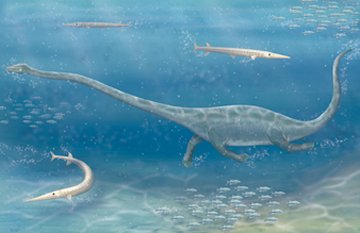
Paleontologists working in southern China recently unearthed the partial remains of Dinocephalosaurus orientalis, which translates as “terrible-headed lizard from the Orient.” The trunk of the creature’s body was less than 1 meter long, but its neck had 25 vertebrae and measured 1.7 m, says Olivier Rieppel, a paleontologist at the Field Museum in Chicago. Like other members of the reptile group called protorosaurs, Dinocephalosaurus had thin bones, or cervical ribs, attached to and extending alongside its neck vertebrae.
“At first glance, those ribs would seem to make the neck stiff and inflexible,” says Michael C. LaBarbera of the University of Chicago. The presence of certain protrusions on the cervical ribs, however, suggest to LaBarbera and his coworkers that the bones served in hunting. When Dinocephalosaurus thrust forward its head to capture prey, muscles that connected the cervical ribs to the neck vertebrae contracted, splaying the ribs and increasing the internal diameter of the animal’s esophagus, says Rieppel. That created suction that pulled water and prey into Dinocephalosaurus‘ maw.
Rieppel, LaBarbera, and Chun Li of the Institute of Vertebrate Paleontology and Paleoanthropology in Beijing describe their analysis of the fossil in the Sept. 24 Science.
Most modern fish and some aquatic reptiles, such as snapping turtles, take their prey via mouth suction. The suction results when muscles in the animals’ mouths rapidly pull down the tongue and floor of the oral cavity.
Expansion of the entire throat, as proposed for Dinocephalosaurus, could have created a much stronger suction, according to P. Martin Sander, a paleontologist at the University of Bonn in Germany. In other protorosaurs, cervical ribs spanned several vertebrae and probably weren’t as mobile as they were in Dinocephalosaurus.
“This is an intriguing fossil,” says Nicholas C. Fraser, a paleontologist at the Virginia Museum of Natural History in Martinsville. The feeding style proposed for Dinocephalosaurus is a “plausible solution for why this animal had such a strange neck,” Fraser says. He adds that the proposal remains speculative because the fossils don’t indicate where muscles attached to the neck vertebrae or the cervical ribs.
The bones in the fossil’s skull and spine were fully ossified, but the bones in the creature’s feet were only partially ossified, says Rieppel. Moreover, the protrusions where foot muscles would have attached were relatively small.
The fossil’s bone-ossification pattern and unusually small foot-muscle attachment sites match those characteristics in modern aquatic reptiles, such as sea turtles, and therefore suggest that the Dinocephalosaurus led a fully aquatic lifestyle.
The newly described specimen of Dinocephalosaurus was found in limestone laid down as sediments in an ancient subtropical ocean. Although the predator probably inhabited shallow waters near the shoreline, the researchers conclude that its remains came to rest at an offshore site at least 200 m deep. Waters of that depth would have protected the carcass from wave action that might otherwise have torn it apart.
Long-necked aquatic creatures such as Dinocephalosaurus presumably were well camouflaged because, in dim or murky waters, the true bulk of an approaching predator could be hidden from the view of prey. Several independent lineages of sea beasts evolved long necks, either by attaining additional vertebrae in the neck, as Dinocephalosaurus did, or by growing longer neck bones.