Reviews
- Quantum Physics
The least physics you need is a lot in ‘Quantum Mechanics’
Leonard Susskind and Art Friedman walk readers through the basics needed to understand the quantum realm.
- Animals
Pets’ rights explored in ‘Citizen Canine’
Science journalist David Grimm describes pet's progression towards full citizenship.
- Physics
‘The Sound Book’ explores echoes, bad acoustics and more
Acoustic engineer Trevor Cox provides an international tour of aural amazements.
- Life
‘The Amoeba in the Room’ uncloaks a hidden realm of tiny life
Mycologist Nicholas Money reveals the secret (and dramatic) lives of amoebas, bacteria, fungi and other often-overlooked microbes in The Amoeba in the Room: Lives of the Microbes.
- Math
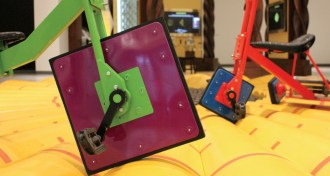
National Museum of Mathematics is antidote to math phobia
New York's National Museum of Mathematics offers a physical, tactile, even rambunctious presentation of math.
- Math
The Improbability Principle
The laws of mathematics and physics suffice to explain a world of coincidences, statistician David J. Hand argues.
- Cosmology
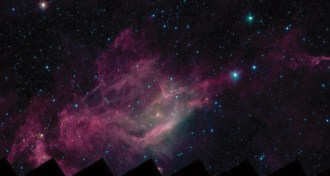
See the sky in a different light
An interactive map lets you explore the galaxy with infrared light.
- Physics
Gravity’s Ghost and Big Dog
Sociologist Harry Collins chronicles the occasionally heated (and often arcane) debates among scientists studying gravitational waves.
- Astronomy
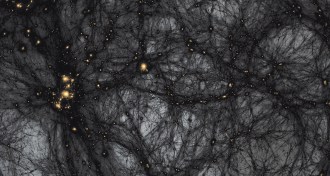
Illuminating a dark universe
The film "Dark Universe" compresses a century of discovery into a crisp, comprehensible half hour.
- Ecosystems
War’s ecological effects laid bare in ‘A Window on Eternity’
In "A Window on Eternity," entomologist E.O. Wilson chronicles both the shifting ecology of Gorongosa National Park after the war and how researchers are trying to repair the damage.
- Tech
‘You Are Here’ maps course for directionally challenged
A Boston Globe technology reporter chronicles the evolution of navigational and mapmaking tools in "You Are Here."
- Tech
To do: Exhibits to explore this May in D.C. and New York
Events include a celebration of science and original watercolor paintings from John James Audubon.